Chapter One
Two Systems, One House
By the editors of this book. Sources checked November 2, 2026.
How plumbing works in a house comes down to two separate systems: one carries clean water in under pressure, and the other lets used water fall out by gravity. They meet at every fixture and never connect. Most of what goes wrong, and most of what you can fix, makes sense once you can tell which of the two you are looking at.
1.1 What are the two systems?
The first is supply. Water arrives from a street main or a well, passes a meter if there is one, and splits into cold and hot branches. It is pushed. A utility in California puts the range a household should see at 30 to 80 psi, and Chapter 7 covers how to measure yours.1 Because it is under pressure all day and all night, a hole in a supply pipe sprays until someone closes a valve.
The second is drainage. Nothing pushes it. Used water leaves each fixture and runs downhill through larger pipes to the sewer or a septic tank, and the only force involved is its own weight. A hole in a drain pipe leaks only while water is running through it. That one difference tells you a good deal when you find a wet spot on a ceiling.
The whole arrangement is shown in Figure 1.1. It is worth a few minutes with a pencil, sketching where those lines run in your own house.
1.2 The supply side in brief
A single pipe usually enters the house. Just inside it, or just outside in warm places, sits the main shutoff, the most useful valve you own. Chapter 6 is about finding it, and if you read only one chapter before something goes wrong, read that one.
From there the cold line branches toward each fixture. One branch feeds the water heater, and the hot line leaves the top of the heater and runs alongside the cold to wherever hot water is wanted. Supply pipes are small, commonly 1/2 inch or 3/4 inch, because pressure does the work. Chapter 3 follows this path in more detail, starting out at the street.
1.3 The drain side in brief
Drain pipes are bigger, and they have to slope. Every horizontal run tilts slightly toward its destination, and the reason and the usual figure are in Chapter 4. The branches collect into a vertical stack and then a building drain, which leaves through the foundation.
Two more parts make the drain side work, and neither is obvious at first glance. Under each fixture is a trap, a bend that stays full of water and keeps sewer gas out of the room. Rising from the drains and out through the roof are vents, which let air in behind moving water. Without vents the water in the traps gets pulled out. Chapter 5 explains both, and they account for a surprising number of gurgles and smells.
1.4 Where can you see both systems at once?
Open the cabinet under a kitchen sink, as in Figure 1.2. It is the best classroom in the house, because the two systems sit side by side, a few inches apart, with nothing hiding them.
The two small lines coming out of the wall are supply. Each has a little valve on it, called a stop, and a flexible line rising to the faucet. The wide pipe with the bend in it is the drain, and the bend is the trap. Put a hand on each while someone runs the water. Supply lines can feel cold or warm but stay still, and the drain carries a sound you can hear.
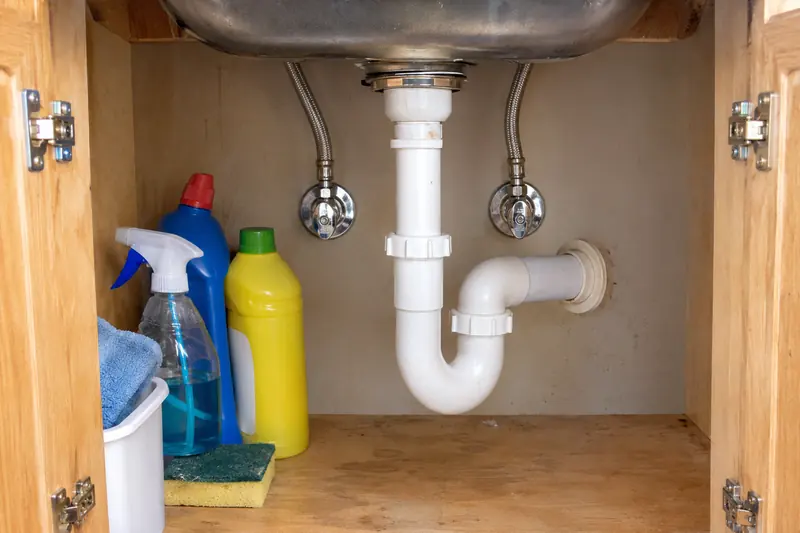
Look also at how the faucet spout ends above the rim of the sink, with open air between them. That gap is deliberate. It keeps dirty water in a full basin from ever being drawn back into the supply. The rule of the house is that supply and drainage stay apart, and most fixtures you own are built around it.
1.5 How do you tell which system has a problem?
A few questions sort most troubles before you touch a tool. They will not diagnose everything, but they will tell you which part of this book to open.
| What you notice | Probably | Start with |
|---|---|---|
| Water comes out weakly | Supply | Chapter 9 |
| A drip when nothing is running | Supply | Chapter 8 |
| A wet spot only when water drains | Drainage | Chapter 28 |
| A sink empties slowly | Drainage | Chapter 16 |
| A smell like sewage | Drainage | Chapter 19 |
| Every drain backs up at once | Drainage | Chapter 20 |
If you have a problem now and no patience for theory, which is reasonable, go to Jump In by Problem. Unfamiliar words are in the glossary. A strong sewage smell, or headaches, dizziness or nausea along with one, is different: get out and call the fire department from outside.3
1.6 Why the book starts here
Plumbers think in these two systems without noticing they do it. A homeowner who picks up the habit stops seeing a tangle of pipes and starts seeing two simple routes, one in and one out. Every later chapter hangs on that picture, and the next one sets out which parts of it are yours to work on.
If your house runs on a well or a septic tank, the picture holds. The source and the destination change, and Chapter 36 and Chapter 21 deal with them. The pipes between work the same way.
Where the line falls
- Yours to do
- Tracing and sketching your own supply and drain lines; looking under sinks and in the basement; learning which pipe is which before anything fails
- For a licensed pro
- Changing how the two systems are laid out; anything on the line from the street or to the sewer; new vents through the roof
Notes
- Rainbow Municipal Water District, "Water Pressure Regulator FAQs." rainbowmwd.ca.gov ↩
- U.S. EPA WaterSense, "How We Use Water." epa.gov ↩
- Wisconsin Department of Health Services, "Sewer Gas." dhs.wisconsin.gov ↩