Chapter Nine
Aerators and Weak Flow
Part Two: Faucets and Fixtures
By the editors of this book. Sources checked November 2, 2026.
A faucet aerator is the small screened fitting at the tip of the spout, and when flow from one faucet turns weak or crooked, a clogged aerator is the first thing to check. It unscrews by hand in most cases. The cure takes about five minutes and costs nothing.
9.1 What does an aerator do?
It mixes a little air into the stream and breaks it into many fine streams, so that a small flow feels like a bigger one and does not splash. It also limits flow. EPA gives the standard for bathroom faucets as 2.2 gallons per minute, and WaterSense models use a maximum of 1.5.1
The screen also catches things. Grit, flakes of scale and bits of old pipe travel along the supply and stop at the first fine mesh they find, which is why this one small part so often gets the blame for a whole faucet's weak flow. Figure 9.1 shows what you may find inside one.
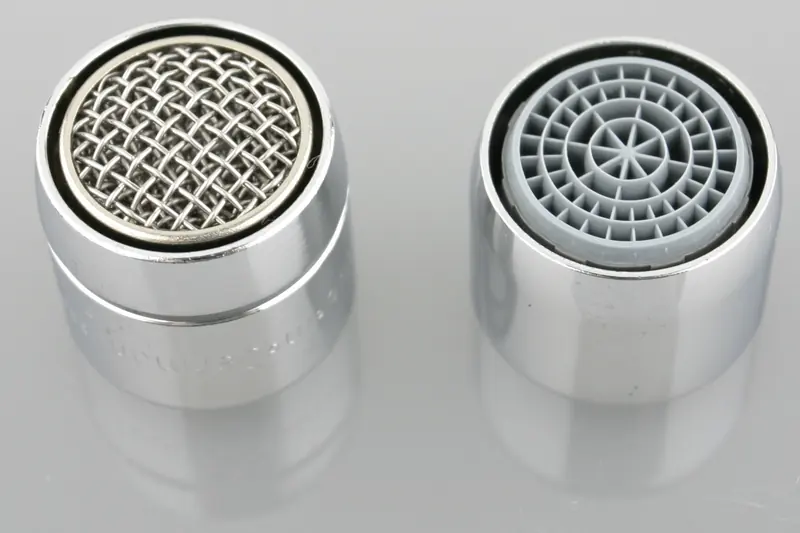
There is a second reason to clean one. EPA says sediment, debris and lead particles can collect in an aerator, and that lead particles caught there can get into your water, so it advises cleaning the screen regularly.2 Chapter 33 has the rest of that subject.
9.2 Is it the aerator or something else?
Test it. Take the aerator off and run the faucet for a moment, hot and then cold. If it now runs strong, the aerator was the trouble. If it is still weak, the problem lies upstream, and the table will point you onward.
| What you see | Likely cause | Where to go |
|---|---|---|
| Strong with aerator off | Clogged aerator | This chapter |
| Weak with aerator off, one faucet | Partly closed stop, kinked connector, clogged cartridge | Chapter 8 |
| Weak everywhere, hot and cold | Whole-house pressure | Chapter 7 |
| Weak hot only, at several faucets | Water heater side | A plumber; start with Chapter 22 |
| Crooked or spraying stream | Scale or grit in part of the screen | This chapter |
You can put a number on it with a gallon jug and a watch. At 2.2 gallons per minute a gallon takes about 27 seconds to fill, and at 1.5 it takes 40. A faucet that needs two minutes is telling you something is wrong.
9.3 How do you clean an aerator?
Close the drain first. Aerator parts are small, and they will go straight down it otherwise.
- Close the sink stopper or lay a towel over the drain.
- Unscrew the aerator clockwise as you look down on it from above, by hand if you can.
- If it will not turn, wrap tape or a rag around the aerator and grip it gently with pliers.
- Take it apart over a towel, and keep the pieces in order, since they go back the same way.
- Rinse each piece, and clear the screen with an old toothbrush.
- Soak scaled parts in white vinegar for an hour or so, then rinse them well.
- Run the faucet for a moment with the aerator off, to flush any loose grit from the line.
- Reassemble the parts and screw the aerator back on, hand-tight.
Vinegar is an acid, so use it by itself. New Jersey's health department warns never to mix cleaning products, especially bleach, and that bleach and acid together make chlorine gas.3 That goes for the sink as well as the bowl you are soaking in. If you recently used bleach or a drain product in that sink, rinse it thoroughly first, and Chapter 18 has more about that.
9.4 How often does it need doing?
There is no set schedule. Do it when the flow changes, and do it after any plumbing work that disturbed the supply, since that always shakes loose some debris. A few minutes once or twice a year keeps the job easy and keeps lead particles from settling in. Houses with hard water get the most scale, and Chapter 34 explains why.
After a water main break or any flushing by the utility, a sudden change at every faucet at once is common. Clean aerators are part of the cleanup. A pull-down kitchen spray has its screen in the spray head, and sometimes a second one at the base of the hose, so check both before you call the flow hopeless.
9.5 Should you replace it with a lower-flow one?
You can, and it is among the cheapest upgrades in the house. EPA says a WaterSense aerator can cost as little as a few dollars, and that labeled faucets and aerators can cut a sink's flow by 30 percent or more, saving the average family about 700 gallons a year.1
To buy one, take the old one with you. Aerators come with inside threads or outside threads, in a few standard sizes, and a kitchen faucet commonly takes a larger flow than a bathroom one. A rough sizing is enough for the store to find a match.
Lower flow is not for every tap. Where you fill pots, you may prefer the higher flow, and you will wait longer for hot water at any faucet that runs slower. Those are matters of taste, and nothing says every sink in the house must match.
9.6 What if nothing helps?
An aerator that is clean and a faucet that is still weak usually means the fix lives somewhere else. Check that the stops are fully open, since a stop half closed after an earlier job is a common cause. If that is fine, look at the cartridge next, as Chapter 8 explains. Beyond that, you may have old pipe narrowed inside, which is a job for a plumber, and Chapter 37 shows you what to look for.
Where the line falls
- Yours to do
- Removing, cleaning and replacing aerators; checking that stops are open; timing flow with a jug; rinsing a pull-down spray screen
- For a licensed pro
- Weak flow that survives every check at the faucet; narrowed old supply pipe; repiping