Chapter Eighteen
Drain Chemicals
By the editors of this book. Sources checked November 2, 2026.
A chemical drain cleaner is a caustic or acid product that can burn skin and eyes on contact, so this book treats it as something you can almost always do without. A plunger and a hand snake clear most clogs and leave nothing behind in the pipe. If the bottle has already been poured, you need the rules in this chapter more than anyone. They are short, and none of them is optional.
18.1 What is in the bottle?
The labels vary, and so does the chemistry, but drain openers are made strong on purpose. National Capital Poison Center says caustic products cause burns on contact with skin, eyes and the digestive tract, and that those chemical burns occur instantly.1 New Jersey's health department records a case in which a plumber cleared a drain at a customer's home with a solvent containing sulfuric acid, on top of bleach already in the pipe, and went to the emergency department with respiratory distress from the chlorine gas that resulted.2
Notice the shape of that case. The plumber was a trained person doing a routine job, and the danger came from what was already in the drain. That is the reason for the last rule below.
18.2 What must you never do?
There are five rules, and every one has the same logic: a pool of unknown chemical is sitting in the pipe, and you must not disturb it or add to it.
- Never mix drain cleaner with anything else. New Jersey warns that mixing bleach with drain openers, ammonia or acid products can release toxic gases, and it lists different brands of drain cleaners as a hazardous mix in their own right.2
- Never pour a second product after the first, however long ago that was, and whatever the second label says.
- Never plunge or snake a drain after pouring chemical in it. The plunger throws it back at you, and the snake brings it up on the cable.
- Never take off a trap, as in Chapter 17, while chemical may be in it.
- Never leave the plumber to guess. Tell them what went in the drain, and when.
The rule about bleach stands apart from drains too. Never mix bleach with anything. New Jersey notes that bleach with an acid produces chlorine gas, and that bleach with ammonia produces chloramine gases, and very high levels of chlorine gas can be fatal.2
18.3 You have already poured it, and the sink is still full
This is the situation in Figure 18.1, and it is common. The product did not work, the water is standing, and it now contains an unknown amount of chemical. It feels as though you should do something. What you should do is very little.
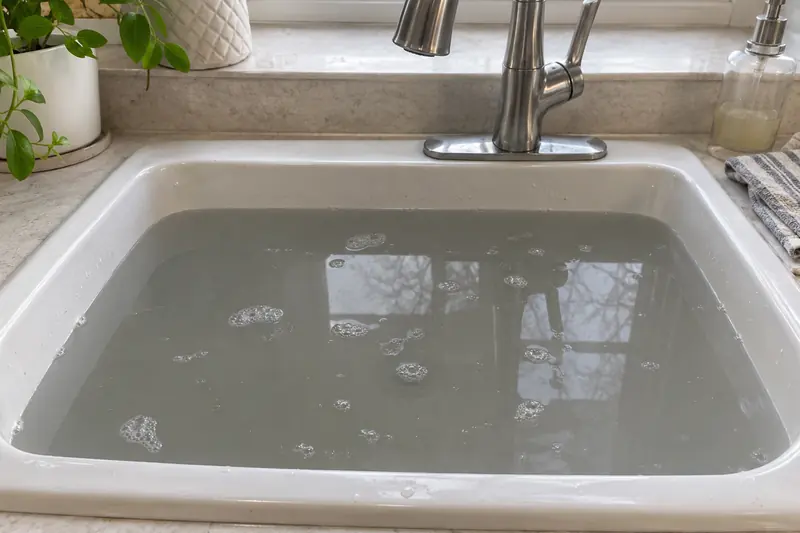
- Stop. Do not plunge, snake, or add anything.
- Keep children and pets out of the room, and put a sign on the sink.
- Keep the bottle, and read its label for what it says about a failed treatment.
- Write down the product and the time you poured it.
- Call a plumber and tell them both before they arrive.
- Tell them again when they arrive.
Do not bail the basin by hand. Do not run the tap to dilute it unless the label says to. The standing water may slowly clear by itself, and if it does, follow the label on flushing. Otherwise, it is a plumber's visit, and it is a better visit for everyone if the plumber knows what to expect.
If the product was poured in the past, even by someone else, say so too. An inherited drain may have a history. A note on the sink about what went in costs nothing.
18.4 If it touches you
For a splash, the first aid comes from the same source. National Capital Poison Center says to rinse immediately with running water for at least 20 minutes, for skin or for eyes, and to remove any clothing with the product on it while rinsing.1 If fumes were breathed in, it says to get into fresh air immediately, and if the product was swallowed, to drink a small amount of water or milk immediately.1 After that, it says to use its online tool or call your poison center. In the US that is the Poison Help line, and the center's article on caustics is a good place to start. Anyone having trouble breathing needs 911.
Twenty minutes is a long time when you are standing at a sink. Keep rinsing anyway.
The same article has a warning about storage: its example is a woman who swallowed a liquid drain opener that had been moved into a water bottle.1 New Jersey's alert says to keep chemicals in their original, labeled containers.2 If you have an old bottle under a sink, read the label, and take it to your local household hazardous waste collection. Do not pour it down the drain to be rid of it.
18.5 What does a chemical do to a septic system?
EPA's advice to septic owners is direct: avoid chemical drain openers for a clogged drain, and use boiling water or a drain snake instead.3 It also tells owners not to pour drain cleaners and other household chemicals down the drain.3 How the tank and drainfield work is in Chapter 21. On a public sewer the reasoning is simpler: whatever you pour stays in pipes that you or a plumber may later have to open.
18.6 What should you use instead?
For nearly every clog, the answer is Chapter 16: a plunger, a hand snake, the trap if you have to. They cost little once, can be used again, and leave the drain safe for whoever comes next. If those do not work, the clog is probably beyond what a bottle could have done anyway, and a plumber with a powered machine is the next step.
If you do decide to use a chemical, in spite of all this, read the entire label before opening it, use one product, wear the eye protection and gloves it calls for, and keep air moving through the room. New Jersey's alert asks for good airflow to prevent fumes from building up.2 Pour once. Then, if it fails, go back to the steps above.
Where the line falls
- Yours to do
- Choosing a plunger or snake over a bottle; reading labels; storing products in original containers; telling a plumber exactly what went down the drain
- For a licensed pro
- Any drain still blocked after a chemical has gone in; a trap holding chemical; a drain with an unknown history that will not clear