Chapter Twenty-One
If You Have a Septic Tank
By the editors of this book. Sources checked November 2, 2026.
Septic system care comes down to regular inspection and pumping, flushing only human waste and toilet paper, keeping grease and chemicals out, and protecting the drainfield. None of it requires you to open anything. That is the first rule of this chapter, and it comes before any of the others: never enter a septic tank or lean into one, because septic gas can kill.
21.1 What must you never do around a tank?
EPA says only trained specialists should clean or repair septic tanks, because tanks may contain dangerous gases.1 The gases collect in a closed space, and they are the same family described in Chapter 19, including hydrogen sulfide. You may not be warned by your nose, since that smell can fatigue quickly.2
Do not put your head over an open tank, and do not climb in to retrieve anything. If someone has collapsed in or at a tank, do not go in after them. Get away from the opening and call 911. Keep lids on, sound and secure, and if a lid is cracked or loose, keep children and pets away and call a septic professional that day.
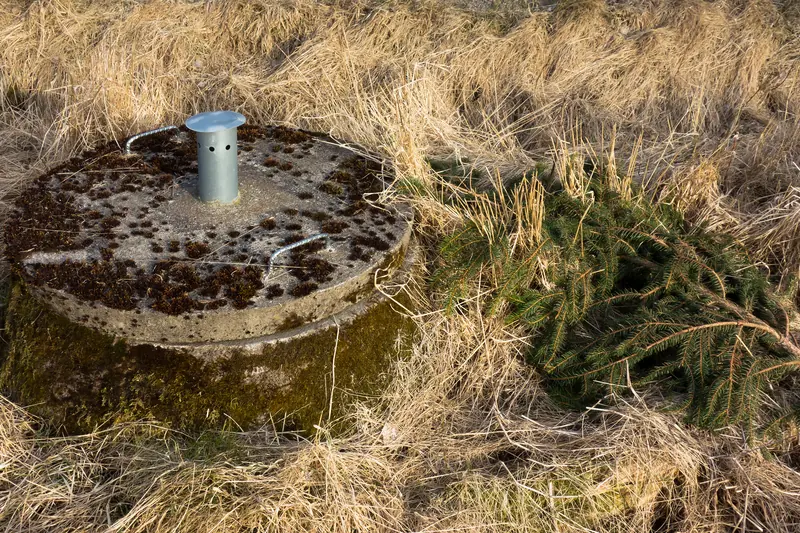
Leave the lid to the person with the pump. Figure 21.1 shows the kind of thing to look for and to mark on your site plan. You should know where it is. You do not need to see inside.
21.2 How does the system work?
Water from the house leaves through the building drain and runs into the tank. Figure 21.2 shows what happens there. EPA describes the tank as holding wastewater long enough for solids to settle to the bottom as sludge, while oil and grease float to the top as scum.3 The liquid in between then moves out to the drainfield, a shallow, covered excavation in unsaturated soil, where it soaks through the ground and is treated as it goes.3
Everything you do as an owner protects one of those two things. Pumping keeps sludge and scum out of the outlet. Watching what goes down the drain slows the rate at which they build. And looking after the drainfield keeps the ground able to accept what the tank sends it. A failed drainfield is a far larger problem than a full tank.
21.3 How often does it need inspecting and pumping?
EPA's general guidance is below.4 A professional's measurement of your own tank is better than any schedule, because household size and habits change the answer.
| What | How often |
|---|---|
| Inspection of an average household system | At least every 3 years |
| Pumping of a household tank | Typically every 3 to 5 years |
| Inspection of an alternative system with electrical float switches, pumps or mechanical parts | Generally once a year |
EPA also gives measurements that the professional checks. It says the tank should be pumped if the bottom of the scum layer is within 6 inches of the bottom of the outlet, if the top of the sludge layer is within 12 inches of the outlet, or if more than 25 percent of the liquid depth is sludge and scum.4 Ask for those readings, and write them down with the date. EPA recommends the same, and after two or three visits you will have a record of how fast your own tank fills.
If you have just bought a house with a septic system, find the records. Your local health department may hold a permit or a site plan, and EPA points to health departments for lists of septic contractors in your area.1
21.4 What is safe to send down the drain?
EPA's rule of thumb is short: flush only human waste and toilet paper.4 Its list of things that should never go in the toilet includes wipes, diapers, cooking grease, coffee grounds and chemicals, because they could clog the system and cause a failure.4
In the kitchen, never pour cooking oil or grease down the drain, and eliminate or limit a garbage disposal, which adds solids and means pumping more often.4 For a clogged drain, avoid chemical openers. EPA says to use boiling water or a drain snake, and Chapter 18 gives this book's other reasons. It also warns against pouring paints, thinners, pesticides and household chemicals down the drain.4 Going easy on water helps too, since spreading laundry out over the week reduces the load the system has to handle at once.5
21.5 How do you look after the drainfield?
You cannot see it, which is why it gets driven over. EPA's advice is plain. Do not park or drive on the drainfield. Plant trees the appropriate distance away, so that roots stay out of the system, and do not plant trees, shrubs or a vegetable garden on it.4 Keep roof drains, sump pumps and other rainwater drainage away from it, since excess water slows down or stops the treatment process.4
Grass is the right cover. If you are planning a deck, a shed, a pool or an addition, find the drainfield on your plan first and talk to the local health department before anyone digs.
21.6 How do you know it is failing?
EPA lists these common signs: water and sewage backing up into the plumbing, tubs, showers and sinks draining very slowly, gurgling sounds in the plumbing, standing water or damp spots near the tank or drainfield, and sewage odors around the tank or drainfield.5 It adds that soft, wet or spongy soil around the drainfield, with no significant recent rain, is a good indication of failure.5
These overlap with the signs of a blocked line in Chapter 20, and on a septic system there is no city to call. Stop using water, avoid contact with any sewage, and call a septic professional and your local health department.5 Do not try to dig up the line or open the tank to look. If sewage has backed up into the house, the cleanup guidance in Chapter 20 applies here as well.
A smell has more than one possible cause. As Chapter 19 notes, EPA says it can come from a blocked or frozen vent or from a downdraft, and it recommends a local provider or plumber to diagnose it.5
21.7 After a flood
A flood can leave a tank and drainfield full of silt and water. EPA has a separate page on it, and it repeats the warning about gases.1 If a well shares your land, read Chapter 36 and do not drink from it until it has been tested.
Where the line falls
- Yours to do
- Keeping the records and the schedule; watching what goes down the drain; limiting the disposal; keeping cars, trees and rainwater off the drainfield; knowing where the lid is
- For a licensed pro
- Opening, entering, inspecting, pumping or repairing the tank; diagnosing odors or backups; any digging or drainfield repair
Notes
- U.S. EPA, "Septic Systems - What to Do after the Flood." epa.gov ↩
- NIOSH, "Pocket Guide to Chemical Hazards: Hydrogen Sulfide." cdc.gov ↩
- U.S. EPA, "How Your Septic System Works." epa.gov ↩
- U.S. EPA, "How to Care for Your Septic System." epa.gov ↩
- U.S. EPA, "Resolving Septic System Malfunctions." epa.gov ↩