Chapter Nineteen
That Smell
By the editors of this book. Sources checked November 2, 2026.
A sewer smell in the house usually comes from a dry trap, a failed toilet seal or a blocked vent, but first be sure it is not gas. If you cannot tell the two apart, treat it as gas and leave. Three different problems can all be described as a rotten-egg smell, and they call for three very different responses. This chapter separates them before it fixes anything.
19.1 Which smell do you have?
The trouble is that the words overlap. Gas companies add an odorant to natural gas to give it a distinctive, pungent smell similar to rotten eggs.1 Hydrogen sulfide, a toxic part of sewer gas, is a colorless gas with a strong odor of rotten eggs.2 3 And water can carry the same smell out of a hot tap. So work through the table in order, and do not be clever about it.
| What you notice | What it probably is | What to do first |
|---|---|---|
| Rotten eggs in the air, near a gas appliance or gas line, or anywhere you cannot explain | Gas leak | Leave the building now |
| Drains, sewage or a stale stink, strongest at a drain or toilet | Sewer gas | If strong, or anyone feels ill, leave. Otherwise look for the cause |
| Rotten eggs only when the hot tap runs, and gone when it stops | Smelly hot water | Check the cold tap, then see below |
| You are not sure | Treat it as gas | Leave the building now |
19.2 If it could be gas
Do not investigate. Do not walk around sniffing for the source. Washington's pipeline safety regulator gives the same basic order for anyone who smells gas indoors: leave right away and do not cause a spark.4
- Leave the building right away, and take everyone with you.
- Do not touch light switches, and do not use a phone, either cell or landline, while inside.
- Do not light anything or start anything.
- Go well away from the building, away from the smell.
- Call 911 and your gas utility from there.
- Stay out until the utility or fire department says it is safe to return.
There is nothing you should do on the way out. Being wrong costs an embarrassing phone call and a short wait on the sidewalk, which is a price you should be happy to pay. A carbon monoxide alarm that sounds gets the same treatment: leave first, and call 911 from outside.
19.3 When is a sewer smell an emergency?
Sewer gas is a mix of toxic and nontoxic gases from decaying waste, and hydrogen sulfide and ammonia are among its most toxic parts.2 Wisconsin's health department says that if you believe concentrations may be high in an enclosed space, you should leave the building and call the fire department.2 It also says to avoid creating an ignition source, such as a spark from an appliance, a match or a lighter.2
So if the smell is strong, get out and call the fire department from outside. Do the same if anyone in the house has a headache, dizziness, drowsiness or nausea. Wisconsin advises seeing a doctor for those symptoms when you suspect sewer gas.2
Do not take comfort if the smell then fades. NIOSH warns that the sense of smell becomes rapidly fatigued and cannot be relied on to warn of the continuing presence of hydrogen sulfide.3 A smell you have stopped noticing may not be gone.
19.4 Where does an ordinary sewer smell come from?
A faint smell with nobody feeling ill is usually a simple matter of a broken barrier between the house and its drains. As Chapter 5 explains, the water in each trap is all that holds drain air back. Wisconsin names floor drains and leaking or blocked roof vents as ways in, and Illinois's health department says sewer drains with dry traps can let hydrogen sulfide gas into the home.2 5
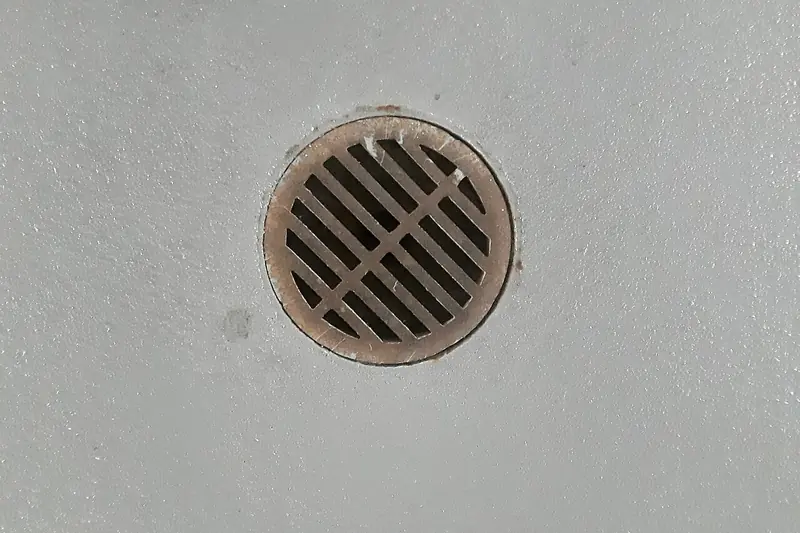
A floor drain is the classic case, because it may never see water at all. Figure 19.1 shows one. So check the things that are seldom used.
- Run water for a minute into every floor drain, and into any sink, shower or tub that nobody uses.
- Flush any toilet that has been sitting idle, including the one in the guest bath.
- Wait a few hours and see whether the smell has eased. If it strengthens or anyone feels ill, get out and call the fire department from outside.
- Sniff around the base of each toilet, since a failed seal is a common source. Chapter 15 covers it.
- Check for a missing or cracked cap on any cleanout you can see. Do not take one off to check.
- Look at the trap under the sink for leaks or drips, and read Chapter 17 if one needs refitting.
- From the ground, look at the plumbing vents on the roof for leaves or a nest.
Wisconsin suggests checking the roof vent for debris like leaves or bird nests from time to time.2 Binoculars from the yard are enough for that. Leave climbing on the roof to someone who does it for a living.
19.5 What if the smell only comes from the hot water?
This is a separate problem, and a far less alarming one. Fill a glass from the cold tap and another from the hot tap, and smell each away from the sink. Do this only if you are sure the air in the house does not smell of gas.
If only the hot glass smells, Penn State Extension says the cause may be chemical reactions inside the water heater. Water heaters are fitted with a magnesium rod to inhibit corrosion, and that rod can chemically reduce sulfates in the water to form hydrogen sulfide.6 It is a fault of the water and the heater, not of your drains. The rod is covered in Chapter 25, but a plumber or the maker's manual should settle what to do about it. Do not remove parts of a heater because of this paragraph, gas or electric.
If both glasses smell, the source is likely the water itself, and that is mainly a matter for owners of wells, as Penn State's page describes.6 Read Chapter 36 and consider a test. If you are on city water and both taps smell, call the utility.
19.6 What if the plain causes do not explain it?
A smell that returns after every trap is wet, that follows a toilet flush, or that comes from inside a wall points to a leak in the drain or vent system. A plumber can test for it, sometimes with a harmless smoke or a pressure test. If you have a septic system, EPA says there may be several reasons for an odor, among them a roof vent that has clogged or frozen and a downdraft caused by wind.7 It adds that the exact cause cannot be diagnosed remotely, and recommends a local septic provider or plumber.7
The by-problem index has the other drain symptoms. A smell along with slow drains everywhere belongs in Chapter 20.
Where the line falls
- Yours to do
- Leaving at once for any possible gas smell; wetting dry traps; checking toilet bases, sink traps and the visible vent from the ground
- For a licensed pro
- The gas utility and fire department for any gas smell; a plumber for a drain or vent leak in a wall, for roof vent work, and for any heater part behind a hot-water smell
Notes
- U.S. Department of Energy, Alternative Fuels Data Center, "Natural Gas Fuel Safety." afdc.energy.gov ↩
- Wisconsin Department of Health Services, "Sewer Gas." dhs.wisconsin.gov ↩
- NIOSH, "Pocket Guide to Chemical Hazards: Hydrogen Sulfide." cdc.gov ↩
- Washington Utilities and Transportation Commission, "Pipeline Emergencies." utc.wa.gov ↩
- Illinois Department of Public Health, "Hydrogen Sulfide Gas." dph.illinois.gov ↩
- Penn State Extension, "Hydrogen Sulfide (Rotten Egg Odor) in Water Wells." extension.psu.edu ↩
- U.S. EPA, "Resolving Septic System Malfunctions." epa.gov ↩