Chapter Twenty-Five
Flushing and the Anode
By the editors of this book. Sources checked November 2, 2026.
To flush a water heater, you cool the tank, drain it through the valve at the bottom with a hose, and rinse out the settled minerals. This is hot-water work, and it should be treated that way from the start. A tank holds many gallons of water hot enough to scald, and you are about to let it out through a garden hose. Done carefully it is an afternoon's chore. Done in a hurry it is how people get burned.
25.1 How often does a tank need flushing?
A. O. Smith says most tank heaters need flushing at least once a year, and more often in hard water.1 Its manual suggests a first flush after six months of use to see how much sediment forms. Little sediment means once a year is enough, and a lot means more often.2 Chapter 34 explains how to find out how hard your water is.
The reason is simple. Hard water leaves sediment in the tank, and A. O. Smith says draining it extends the life of the tank, the heating elements and the drain valve.2 If an old tank has never been flushed, take particular care with the first drain. The bottom may be thick with deposits that clog the drain valve or keep it from closing cleanly afterward.
25.2 Which heaters should you flush yourself?
That depends on the fuel, and Chapter 22 shows how to tell.
Gas heaters. Follow the procedure in the manual for your exact model. Many owners leave it to a plumber, and we think that is a sensible choice. This book gives no steps at the gas control or the burner, and those are part of the job on a gas heater. Before you start, read the printed label. If you smell gas, leave the building first, touching no switches and using no phone inside; call 911 and the gas utility from outside and well away, and stay out until they clear it.
Electric heaters. The steps below apply, alongside your own manual. The rule that governs them is short. The breaker goes off before you touch anything and stays off through the whole job, until the tank is full again and air has stopped coming out of a hot tap. An element that gets power while dry can burn out quickly.
25.3 How to flush an electric tank
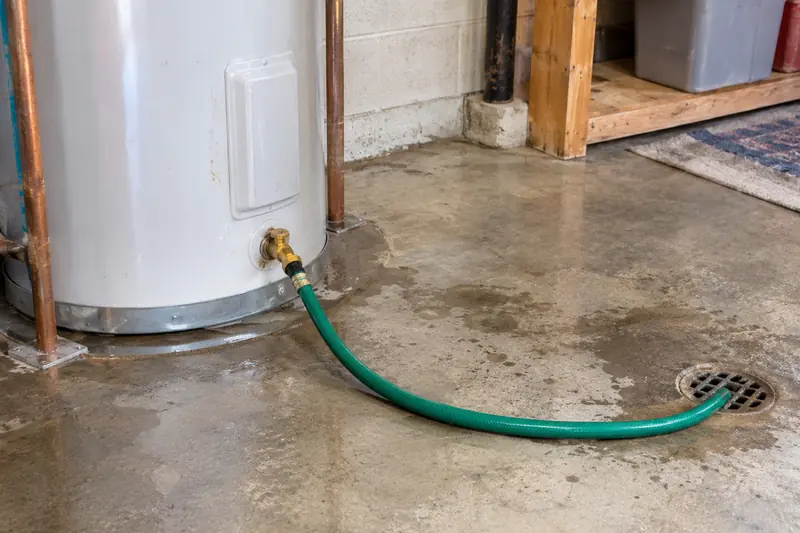
Figure 25.1 shows the hose in place. Have the hose, a helper who knows the plan, and a clear route to a drain ready before step 1. Wear closed shoes.
- Switch the water heater breaker off. Leave a note on the panel so that nobody turns it back on.
- Open a hot tap and let it run until the water is cool, which lowers the risk of a scald when you drain the tank.2
- Screw a garden hose to the drain valve and lead the other end to a floor drain or outside, somewhere the water cannot reach anyone.2
- Close the water heater valve on the cold in pipe.
- Open the drain valve, and leave a hot tap open so that air can enter the tank as it empties.2
- When the tank has drained, and only if sediment came out, open the water heater valve and let the water run until no more sediment drains.2 Then close that valve again.
- Close the drain valve and take off the hose.
- With a hot tap still open, open the water heater valve fully so that the tank fills.2
- Let that hot tap run full for at least three minutes, as the maker says, so that all the air is out and the tank is completely full.2 Then close the tap.
- Check the drain valve for drips. Only now switch the breaker back on. The maker says the tank may take two hours to heat up.2
25.4 What can go wrong?
Three things go wrong most often, and the breaker stays off for all of them.
If nothing comes out of the hose, sediment may have clogged the valve. A. O. Smith's advice is to call a qualified person if the tank will not drain.2 Close the drain valve, refill as in steps 8 and 9, and make the call before forcing anything.
If the drain valve will not close, or it drips after closing, keep the water heater valve closed. Leave the breaker off and call a plumber.
If the water heater valve will not shut completely, water will keep running through the tank. Your whole-house option is the main shutoff in Chapter 6, and this too is a plumber's visit.
Rusty water or a wet spot on the tank's skin is another matter. Tanks do not get repaired. Replacing the heater is licensed work in this book.
25.5 What does the anode rod do?
The anode rod corrodes so the tank does not. A. O. Smith recommends inspecting it once a year,1 and its manual says to replace it when it is substantially worn or depleted, and that a water softener wears it faster.2 Chapter 35 says more about softeners.
In practice, getting it out is awkward. On many heaters it needs a large socket, a good deal of force, and room above the tank, and an old rod may refuse to move. If a plumber is coming for another reason, ask them to pull it and show it to you. A look at the rod tells you how the tank is faring. On a gas heater, leave it to them.
Replacement rods and other parts appear in PlumbingSupplyAndMore's water heater parts section (PlumbingSupplyAndMore has the same owners as this book), which is one place to look, and not the only one. Bring your model number, because parts vary by heater.
25.6 Why does my hot water smell like rotten eggs?
A. O. Smith's manual says harmless bacteria that are normally in tap water can multiply in a heater and make that smell, and that a qualified person can sometimes help by changing the anode.2 This is a smell in the hot water, and it appears when you run the tap.
A smell of gas in the air is different. Do not stay to work out which one you have. If the air around the heater or in the house smells of gas, leave first, as above.
Where the line falls
- Yours to do
- Flushing an electric tank by your manual with the breaker off from first step to last; yearly flushes on a calendar; keeping the hose route clear; noting what color the water runs
- For a licensed pro
- Flushing a gas heater if you would rather not follow the manual yourself; pulling a stuck anode; a seized or leaking drain valve; any rust or seep from the tank
Notes
- A. O. Smith, "Water Heater Maintenance Guide." hotwater.com ↩
- A. O. Smith, "Residential Electronic Thermostat Electric Water Heater: Installation Instructions and Use & Care Guide." assets.aosmith.com ↩