Chapter Thirty-Five
Filters and Softeners
Part Seven: What Is in the Water
By the editors of this book. Sources checked November 2, 2026.
A water softener and a filter do different jobs: the softener removes hardness minerals, and a filter is meant to catch particular things you have named. Buying one when you need the other is the commonest mistake in this territory. Neither should come before a test. Start from a number, from Chapter 32 or from Chapter 34.
35.1 What does each one actually do?
A softener passes water through a resin or zeolite that releases sodium ions and takes up calcium and magnesium.1 When the resin is spent, it goes through a cycle called regeneration, which backwashes it with salt solution and sends the brine down the drain.1
A filter is a broader word. The Minnesota Department of Health describes a carbon filter as one where contaminants build up on the filter while water passes through. Reverse osmosis pushes water through a membrane with tiny pores that stops many contaminants while letting water through.2 Which filter you need depends on what you are trying to remove, and MDH is blunt that no single treatment unit can remove all contaminants.3
| Equipment | What it does | What to watch |
|---|---|---|
| Softener | Trades calcium and magnesium for sodium | Salt, about 50 gallons of water per regeneration, added sodium |
| Carbon filter | Holds contaminants on the filter | Harmful bacteria can grow if not maintained and replaced |
| Reverse osmosis | Membrane stops many contaminants | Can create a lot of wastewater; may need pretreatment |
The figures in that table come from Penn State and from MDH.1 2 Certified claims vary by product, so read the certificate for the model you are looking at, not the type.
35.2 Is a softener a lead filter?
No. Do not count on one for lead. Softening removes hardness minerals, and Penn State says softeners will not necessarily remove the more serious drinking water contamination problems.1 MDH goes further and warns that softened water can corrode pipes, which can contribute to elevated lead and copper levels.4 The guidance on lead names a filter certified to NSF/ANSI 53 for lead and 42 for particulates, as we saw in Chapter 33.5
Softened water is not filtered water, and filtered water is not softened water. Some homes have both, doing separate work.
35.3 Where does the equipment go?
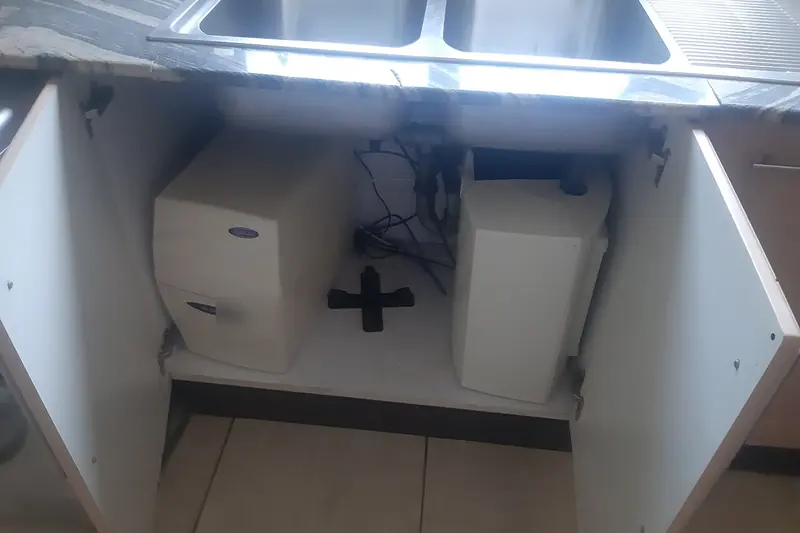
There are two places. A point-of-use unit treats water at one faucet: a pitcher, a countertop unit, a faucet attachment, a refrigerator dispenser, or a housing under the sink like Figure 35.1. A point-of-entry unit goes on the water line where it enters the house and treats all of it.3 MDH calls point-of-use a good option for treating only drinking and cooking water, which is most of what most people mean to treat.3
Reverse osmosis at one tap is a typical point-of-use job. One example is SoftPro's reverse osmosis system page (SoftPro Water Systems has the same owners as this book). It is one place to look, and you should still check that any model's certification covers what you are trying to remove.
35.4 How do you tell whether a claim is real?
Ask for the certificate, then look it up. MDH says to select a unit certified by NSF, Underwriters Laboratories or the Water Quality Association, for the specific contaminant you care about, where a certification exists.3 NSF keeps a searchable listing of certified units. Certification is for a named model and a named claim, so "certified" alone means little.
- Test the water and write down what you found.
- Name the one or two things you want gone.
- Find a unit certified to remove those things by name.
- Read what the filters or the salt will need, and how often.
- After it is installed, test the treated water to see that it is working.
35.5 What upkeep are you signing up for?
All of it. MDH says all treatment units need regular maintenance, which can mean changing filters, disinfecting, backwashing or clearing scale. Units left alone lose their effect, and in some cases can make the water worse and make you sick.3 A carbon filter left too long can become saturated and start to release what it caught.2 If you will not change a cartridge on schedule, you are better off without it.
35.6 What happens to the salt?
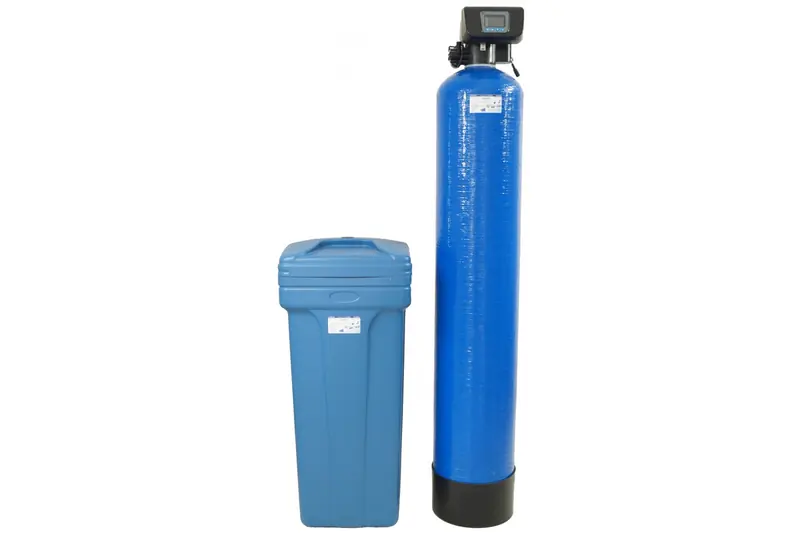
A softener like Figure 35.2 sends its brine to a drain. Penn State estimates about 50 gallons of water for each regeneration cycle.1 On a septic system, you should think about the extra load on the drainfield, and Penn State says it may or may not cause overload, which is the reason to ask first.1 Chapter 21 explains why the drainfield matters. On a private system, MDH notes, the chloride ends up in lakes and streams.4
The rules on discharge vary locally. Dublin San Ramon Services District in California, for one, discourages automatic softeners because the salt raises the salinity of its recycled water.6 Other places may restrict them. Ask your sewer utility or septic authority before you buy. Softening with potassium chloride instead of sodium chloride is MDH's suggestion for limiting sodium in the water you drink, and it also suggests keeping one unsoftened tap for cooking and drinking.4
If you still want a softener once those questions are answered, Quality Water Treatment's softener page (Quality Water Treatment has the same owners as this book) is one place to look. Others sell them too. Santa Cruz County, California, as one example of local rules, requires a plumbing permit when treatment equipment is installed unless the work is specifically exempted, so ask your own building department.7
Where the line falls
- Yours to do
- Testing first; changing cartridges in a point-of-use unit; refilling softener salt; reading a certificate; retesting treated water
- For a licensed pro
- Cutting a whole-house unit into the main line; a new drain or an air gap for a softener or reverse osmosis unit; any treatment install your town wants permitted
Notes
- Penn State Extension, "Water Softening." extension.psu.edu ↩
- Minnesota Department of Health, "Home Water Treatment" (PDF). health.state.mn.us ↩
- Minnesota Department of Health, "Home Water Treatment." health.state.mn.us ↩
- Minnesota Department of Health, "Home Water Softening." health.state.mn.us ↩
- CDC, "Lead in Drinking Water." cdc.gov ↩
- Dublin San Ramon Services District, "Water Softeners." dsrsd.com ↩
- County of Santa Cruz, "When is a Plumbing Permit Required?" cdi.santacruzcountyca.gov ↩