Chapter Thirty-Three
Lead
Part Seven: What Is in the Water
By the editors of this book. Sources checked November 2, 2026.
Lead in drinking water comes from plumbing, when materials that contain lead corrode. You cannot see, taste or smell it, so an ordinary glass tells you nothing.1 2 This chapter stays close to what EPA and CDC say, because this is not a subject for a neighbor's opinion. The sources are listed at the end, and they are worth reading yourself.
33.1 Where does the lead come from?
Where a lead service line exists, it is typically the most significant source.2 That is the pipe that brings water from the street, described in Chapter 3. Brass or chrome-plated brass faucets and plumbing with lead solder can also add it.2 Household fixtures, solder and fittings made before 1986 may contain lead, according to CDC.3 EPA says lead pipes are more likely in older cities and in homes built before 1986.1
A newer house is not automatically clear. "Lead-free" in plumbing has a legal meaning: a weighted average of 0.25 percent lead on wetted surfaces of pipes and fittings, and 0.2 percent in solder and flux.1 Softened water can also corrode pipes, and the Minnesota Department of Health says that corroded metal can contribute to elevated lead and copper in drinking water.4
33.2 How can you check your own pipe?
EPA's quick check takes a penny or a key and a magnet.5 Do it where the service line comes into the house, usually near the main shutoff you found in Chapter 6. Figure 33.1 shows the kind of pipe you are looking for. If you cannot reach the pipe, ask your water utility, or a licensed plumber if the utility has no record.1
- Find the pipe where it enters the house, ahead of the main shutoff.
- Hold a magnet to it. A magnet sticks to galvanized steel and does not stick to copper, plastic or lead.
- If the magnet does not stick, look at the color. A penny color means copper.
- If the pipe is dull gray and the magnet does not stick, scratch one small spot gently with the edge of a key or a penny. EPA says a lead pipe turns bright silver where scratched.6
- Stop there, and call your utility with what you found.
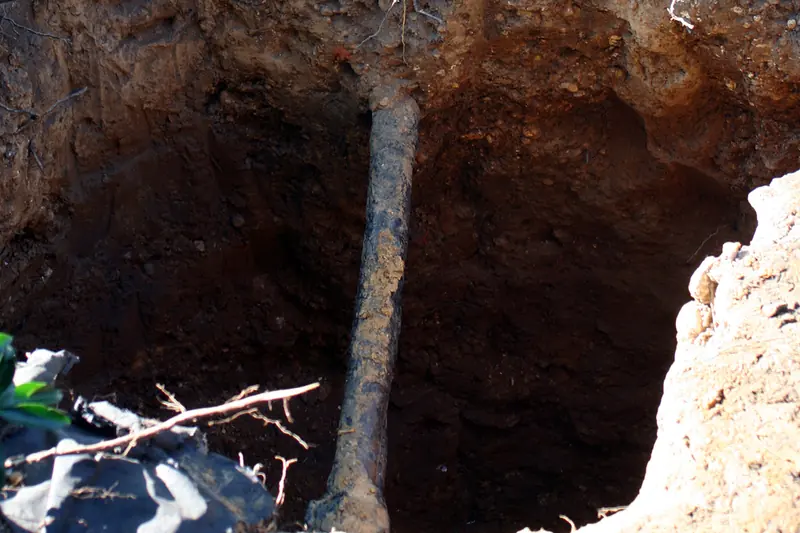
EPA is firm about step 4: do not use a knife or other sharp instrument, and take care not to puncture the pipe.6 Otherwise leave old pipe alone. Do not sand it, cut it or scrape it, and do not try to clean it. One pipe at the wall also does not settle the question, since a line can change material under the yard. The utility may hold records for the rest.
33.3 What can you do today?
None of these steps needs a tool, and all of them come from EPA and CDC.
- Flush before drinking. Run the tap, take a shower, do a load of laundry or a load of dishes.1 How long depends on your service line, so ask your utility for the time in your community.
- Use cold water only for drinking, cooking and making baby formula.1 Water that comes out of the tap warm or hot can have more lead in it.3
- Do not boil it away. Boiling does not remove lead.1
- Clean the aerator. Sediment and lead particles can collect in the faucet screen, so EPA says to clean it regularly.1 Chapter 9 shows how to take it off.
- Use a certified filter if you use one at all. CDC says to look for certification to NSF/ANSI standard 53 for lead removal and NSF/ANSI standard 42 for particulates.3
EPA says bathing and showering should be safe for you and your children, since skin does not absorb lead from water.1
33.4 Is testing worth it?
Yes. EPA calls testing the only sure way of telling whether your water has harmful amounts of lead.1 Send samples to a certified laboratory, and follow its directions for collecting them at the faucets where you drink. EPA puts the cost at $15 to $100.5 Your state or your local water company can point you to a certified lab, and some states or utilities have programs that pay for testing.5 CDC adds that many public water systems will test on request, so ask before you pay.3
The yearly report in Chapter 32 gives results for the whole system, so it cannot stand in for this test. Your own tap has its own plumbing behind it.
33.5 Who replaces a lead line?
Not you. A service line is work for the utility or a licensed plumber, and ownership can be split, with the system controlling one portion and the owner another. Ask your utility which part is yours.1 Ask at the same time whether it offers help with the cost, because some states and utilities have programs that pay for lead service line replacement.5
Do not dig for it, and do not cut it. Inside the house, keep to the checks above. If you are planning a repipe or a remodel anyway, raise it with the plumber early, as Chapter 38 suggests, and Chapter 39 covers how to choose one.
33.6 What about your family's health?
This book does not give health advice beyond what these sources say. CDC says to contact your child's healthcare provider if you think you or your child has been exposed to lead in water, and that the best way to tell is a blood lead test.3 It also notes that infants who drink formula made with lead-contaminated tap water may be at higher risk, which is why the cold water rule above names formula.3
Where the line falls
- Yours to do
- Checking the pipe with a magnet and a key, gently; flushing; cold water for drinking, cooking and formula; cleaning aerators; ordering a certified lab test; changing a certified filter on schedule
- For a licensed pro
- Replacing a lead service line or any part of it; opening, cutting or repiping old lines; swapping suspect solder joints; anything at the street, which is the utility's to answer
Notes
- U.S. EPA, "Basic Information about Lead in Drinking Water." epa.gov ↩
- U.S. EPA, "Protect Your Family from Sources of Lead." epa.gov ↩
- CDC, "Lead in Drinking Water." cdc.gov ↩
- Minnesota Department of Health, "Home Water Softening." health.state.mn.us ↩
- U.S. EPA, "Protect Your Tap: A Quick Check for Lead." epa.gov ↩
- U.S. EPA Region 5, "Advice for Chicago Residents about Lead in Drinking Water." epa.gov ↩