Chapter Six
Finding Your Shutoffs
By the editors of this book. Sources checked November 2, 2026.
The main water shut off valve is usually where the water line enters the house, often on a basement or garage wall or near the water heater, and closing it stops water everywhere inside. Find it today. A burst pipe gives you a few minutes at most, and you do not want to spend them with a flashlight.
6.1 Where is the main shutoff?
Look first along the wall nearest the street, at floor level or just above it, where a pipe comes through the foundation. Basements, crawl spaces, garages, utility closets and the space behind a water heater are the common places. In warm places it may be outside on an exterior wall, in a covered box next to the house.
Figure 6.1 shows how the valves relate to each other. If you can find the Meter, the pipe leaving it on the house side leads you to the Main shutoff. Your home inspection report, if you kept it, may also say where it is. Nearby you may also find a pressure regulator, which one California utility describes as the customer's to install and maintain, on the customer's side of the meter.1
Do not confuse it with the valve out by the street. A curb stop or street-side valve belongs to the utility, and it is not yours to operate. If the valve at your house does not exist or will not work, call the utility and a plumber.
6.2 What kinds of valves will you find?
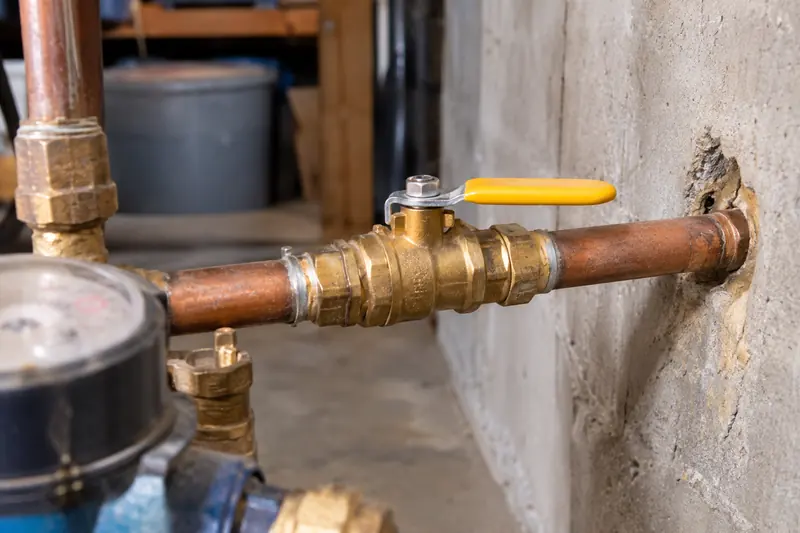
Two types do almost all the work. A ball valve, like the one in Figure 6.2, has a lever that makes a quarter turn. When the lever runs along the pipe, it is open, and when it stands across the pipe, it is closed. It is easy to read and slow to wear.
A gate valve has a round wheel handle that takes several turns clockwise. It is older and is often found in older houses. Gate valves that have sat open for decades may not close all the way, and may weep at the stem when you do turn them. Sometimes a very slight tightening of the small nut below the handle will stop that. Sometimes the valve needs replacing.
A globe valve looks like a gate valve from the outside and behaves about the same, so you need not tell them apart today.
6.3 What are the other shutoffs for?
You should not have to shut down the whole house for one faucet. Most fixtures have their own valves, as the table shows, and they earn their keep over the years. EPA says the average household's leaks waste more than 9,300 gallons a year, and a single faucet dripping once a second can waste more than 3,000.2
| Valve | Where | What it stops |
|---|---|---|
| Fixture stops | Under sinks, behind toilets | One faucet or toilet |
| Water heater valve | On the cold line above the heater | Cold water going into the tank, so hot water everywhere soon stops |
| Hose faucet | Outside wall, sometimes with a separate inside valve | Water to that faucet |
| Washer valves | In the box behind the washer | The washer; see Chapter 11 |
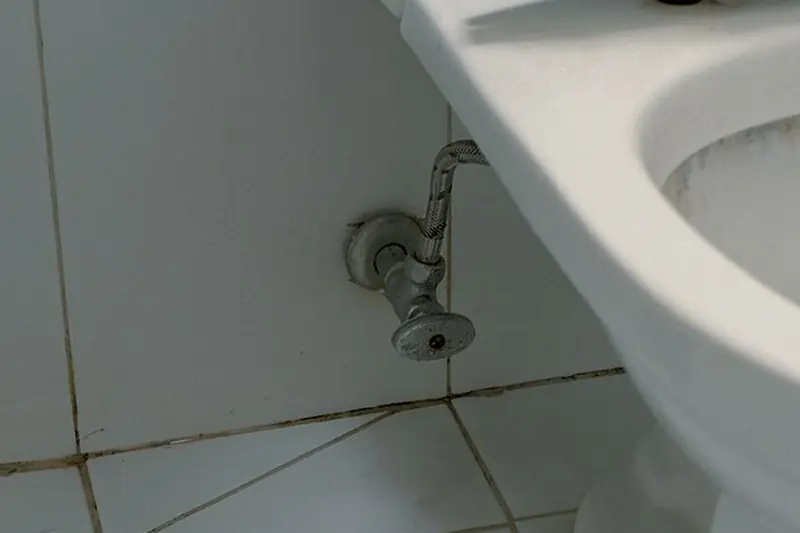
The small valve under a sink or beside a toilet, as in Figure 6.3, is called a stop. The kind that comes out of the wall and turns up at a right angle is called an angle stop. Older ones have a small oval handle, and newer ones may have a quarter-turn lever.
Showers are the common exception. Many have no stop of their own, so working on one means closing the main, as Chapter 10 explains.
The Water heater valve closes only the water side. Any handle on a gas line near the heater is not part of this chapter, and you should leave it alone. Chapter 22 covers what else is on the tank.
6.4 How do you test them?
A valve you have never closed is a guess. Pick a quiet time, with a bucket and a towel nearby, and try each one. Do this when you have an hour free and the hardware store is open, in case something weeps afterward.
- Find the main shutoff and clear anything stored in front of it.
- Close it, slowly, using your hand and no wrench.
- Open a cold faucet on the top floor and a cold faucet on the lowest floor, and wait until both stop running.
- Close the top faucet and leave the low one partly open.
- Open the main shutoff slowly, and let the low faucet run until the sputtering ends, then close it.
- Run the top faucet until it, too, runs smooth, then close it.
- Close and reopen each fixture stop by hand, and check it for drips once it is back open.
- Put a tag on the main shutoff, and show everyone who lives in the house where it is.
Go gently on an old valve. Forcing a stiff handle is how a stem breaks and how a quiet Saturday gets expensive. If a stop drips at the stem after you test it, a small snug of the packing nut with a wrench may cure it, and if not, it is due for replacing.
6.5 What if a valve will not close?
Do not put a long wrench on it. An old valve that will not turn may crack, and an old pipe behind it can twist and let go. If a fixture stop will not close, you can use the main instead and replace the stop while the water is off. If the main will not close, call a plumber to replace it before you need it.
Where a replacement is needed, a licensed plumber can usually fit a new ball valve at the main, working with the utility if the water must be shut off at the street. Many careful owners replace their own stops under sinks when they are compression fittings. You can see what is available in PlumbingSupplyAndMore's ball valves section (PlumbingSupplyAndMore has the same owners as this book) and its angle stop section (PlumbingSupplyAndMore has the same owners as this book). They are one place to look, not the best.
6.6 When the water is already running
Go straight to the main and close it. If water is on the floor near outlets, a panel or appliances, do not walk through it to get there. Use a breaker only if you can reach it from a dry spot, and otherwise call the utility or fire department from outside. Chapter 29 goes through the rest of those first minutes. Cold snaps are when many people first need this valve, since pipes in attics, crawl spaces and outside walls are the vulnerable ones, and Chapter 30 covers them.3
If your home has an electric water heater and the water will stay off for some time, nothing needs doing to the heater as long as the tank stays full. An empty tank with the power on burns out its elements, so switch off the breaker as soon as you suspect the tank has drained, and leave it off until the tank is full again.
Where the line falls
- Yours to do
- Finding, labeling and testing the main shutoff and every stop; closing them in an emergency; snugging a packing nut; replacing a compression stop under a sink
- For a licensed pro
- Replacing a main shutoff; anything at the street, including curb stops; soldered stops; valves that will not turn; any handle on a gas line
Notes
- Rainbow Municipal Water District, "Water Pressure Regulator FAQs." rainbowmwd.ca.gov ↩
- U.S. EPA WaterSense, "Fix a Leak Week." epa.gov ↩
- Kentucky Division of Water, "Prevent Pipes From Freezing." eec.ky.gov ↩