Chapter Seven
Water Pressure
By the editors of this book. Sources checked November 2, 2026.
Normal water pressure for a house falls between 30 and 80 psi, and about 50 psi is often a good place to be, according to one California water district.1 Local utilities differ, so ask yours what to expect. You can find your own number in about five minutes, with a gauge from the hardware store.
7.1 How do you test your water pressure?
Buy a pressure gauge with a hose-thread fitting. It costs little, and it will settle arguments for years. The district's method is a gauge on a hose faucet with all other water in the house off.1 Figure 7.1 shows what it looks like in place.
- Turn off every faucet, and make sure the washer, dishwasher and icemaker are not filling.
- Thread the gauge onto a hose faucet, hand-tight.
- Open the faucet fully and read the needle.
- Close the faucet, loosen the gauge a little to let the water out, and take it off.
- Repeat at a different time of day, since street pressure can change with demand.
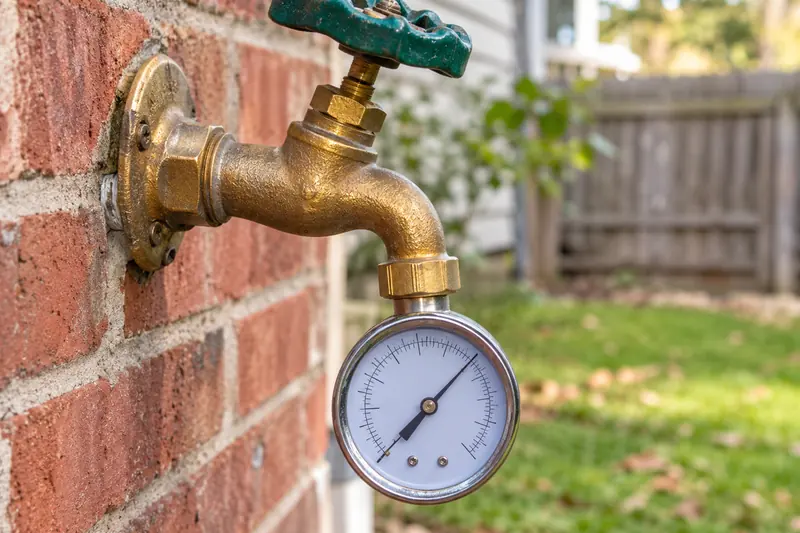
Some gauges have a second, lazy needle that stays at the highest reading. If you leave one of those on overnight and find a much higher mark in the morning, you have learned that pressure spikes when no one is awake to watch, which a single daytime reading would have missed.
If the faucet you use comes off before a pressure regulator, you will be reading the street's pressure and not the house's. If you are unsure which it is, take a second reading at a laundry or utility faucet indoors, if it has a hose thread. Chapter 3 shows the order in which those parts usually appear.
7.2 What does high pressure do?
High pressure is hard on things you cannot see. It can wear out washers and cartridges early, make valves slam, and put a steady strain on hoses and supply lines. The district lists high water pressure, a faucet leak and a toilet running constantly among the signs of a failing regulator.1 If you have a run of drips and running toilets all at once, measure the pressure before buying more parts.
Noises can also point here. Banging and thumping when a valve closes, which is the subject of Chapter 31, is worse at high pressure.
A relief valve on a water heater that drips can be connected too, though that is a plumber call. Never put a cap or plug on the valve or its pipe, for reasons given in Chapter 24.
7.3 What does low pressure mean?
Sort it by how widely it shows. One faucet weak while the others are fine almost always means something local, and an aerator is the first thing to check. Chapter 9 takes five minutes and needs no plumber.
| What you see | Often means | Start with |
|---|---|---|
| One faucet weak, hot and cold | Clogged aerator or cartridge | Chapter 9 |
| Hot water weak everywhere, cold fine | Something on the water heater side | A plumber; start with Chapter 22 |
| Whole house weak, sudden | Partly closed main shutoff, utility work, or a leak | Chapter 28 |
| Whole house weak, gradual | Failing regulator, or old pipe narrowing inside | Chapter 37 |
| Upstairs weak, downstairs fine | Height, plus some of the above | Measure first |
| Weak on a well | Pump, pressure tank or filter | Chapter 36 |
Check the easy things first. A main shutoff left partly closed after some earlier job is common, and it is simple to open fully. Ask a neighbor whether theirs is low as well, and if so, call the utility.
Pressure and flow are not the same thing. The gauge can read a healthy 60 psi with no water running, while a corroded pipe still delivers only a dribble at the tap. That is one reason to look at old pipe if the reading is fine and the flow is not, and Chapter 37 shows you what to look for.
7.4 What is a pressure regulator?
A pressure regulator is a bell-shaped brass valve that takes the high pressure in the street and lowers it to something a house can live with. It usually sits next to the main shutoff, though not every house has one, since not every street needs one. The district puts the responsibility for installing and maintaining one with the customer, on the customer's side of the meter.1
The usual life, by the same source, is 10 to 15 years.1 When one is wearing out, you may see fluctuating or diminishing pressure, little or no pressure at all, noises in the walls, or high pressure with leaks and running toilets. Those signs are worth checking against your gauge before you call anyone.
7.5 Can you adjust or replace one yourself?
Many regulators have an adjusting screw on top, with a locknut. Turning it changes the setting. It is a job with few steps, but it is easy to make things worse if you do not know the valve's condition, and an old one may not respond. If your reading is outside the range, we would let a plumber look at it and set it, and keep your gauge for checking the result.
Replacing a regulator is on the licensed side of the line. It means shutting off the main and cutting in on the pipe, and in some towns it may need a permit. Ask your local building department or your plumber. If you want to see what these valves are, there are examples in PlumbingSupplyAndMore's pressure reducing valves section (PlumbingSupplyAndMore has the same owners as this book). That is one place to look, and we do not call it the best.
If your town's water is low and always has been, a regulator will not help, since it can only lower pressure. Raising it takes a booster pump, and that is another job for a plumber.
7.6 What about pressure and water use?
A lower setting within the normal range means less water through every open tap, and it reduces stress on everything. WaterSense labeled showerheads, which use no more than 2.0 gallons per minute, must provide a minimum flow across a range of household pressures.2 If your showers are weak at 60 psi, then, the showerhead is probably not the whole story, and Chapter 10 is the next stop.
Where the line falls
- Yours to do
- Testing pressure with a hose gauge; checking that the main shutoff is fully open; cleaning aerators; asking the utility about street pressure
- For a licensed pro
- Adjusting, replacing or adding a pressure regulator; booster pumps; repiping old narrowed lines; a dripping relief valve
Notes
- Rainbow Municipal Water District, "Water Pressure Regulator FAQs." rainbowmwd.ca.gov ↩
- U.S. EPA WaterSense, "Showerheads." epa.gov ↩