Chapter Twenty-Two
How a Water Heater Works
By the editors of this book. Sources checked November 2, 2026.
A water heater works by keeping a tank of water hot and letting it out the moment a hot tap opens, while cold water from the house supply moves in to replace it. That is nearly the whole idea. The hot water is not pumped anywhere. Pressure from the cold side pushes it out, and that same pressure is why the tank has to be built strong and watched by a safety valve.
22.1 What happens when you open a hot tap?
Hot water is lighter than cold, so it gathers at the top of the tank. The outlet is up there too. When you open a tap, the water at the top leaves through the hot supply we traced in Chapter 1, and the same volume of cold arrives to take its place.
If cold water simply poured in at the top, it would mix with the hot water you were about to use. So it is sent to the bottom through a long tube. The hot layer stays on top and the shower stays warm for a good while, until the cold layer has risen far enough to reach the outlet. Then the water goes lukewarm rather quickly. That is what running out of hot water feels like from inside the tank.
When the temperature falls below the setting, a thermostat calls for heat. The heater warms the tank, stops, and waits. A storage heater repeats that all day, whether or not anyone is home.
22.2 The parts, from top to bottom
Figure 22.1 shows a tank cut in half. Most of these parts come up again in the next few chapters, so it is worth learning their names once.
| Part | Its job |
|---|---|
| Cold in | Brings water from the house supply |
| Dip tube | Carries that water down to the bottom of the tank |
| Hot out | Sends hot water from the top of the tank to the house |
| Anode rod | Corrodes in place of the tank |
| Heat source | Warms the water: a burner or electric elements |
| Sediment | Minerals that settle on the bottom |
| Drain valve | Lets the tank be emptied |
| Relief valve | Opens if heat or pressure climbs too far |
| Discharge pipe | Carries that release to a safe place |
The relief valve gets its own chapter, Chapter 24, because it is the one part you must never interfere with. The drain valve and the anode rod are the subject of Chapter 25.
22.3 How do electric and gas heaters differ?
They store water the same way and differ only in how they heat it. Most electric heaters have two thermostats, and the elements that do the heating sit inside the tank, with the water in contact with them.1 That is why an electric heater must never have power while the tank is empty. An element out of water burns out quickly.
A gas heater has a burner under the tank and a flue that runs up through the middle, carrying exhaust out through a vent. The fire and the exhaust are the reason gas heaters ask for more caution. This book gives no instructions for the gas control, the burner, the gas connection or the vent. Those belong to the printed label on your heater, its manual, your gas company and a licensed plumber.
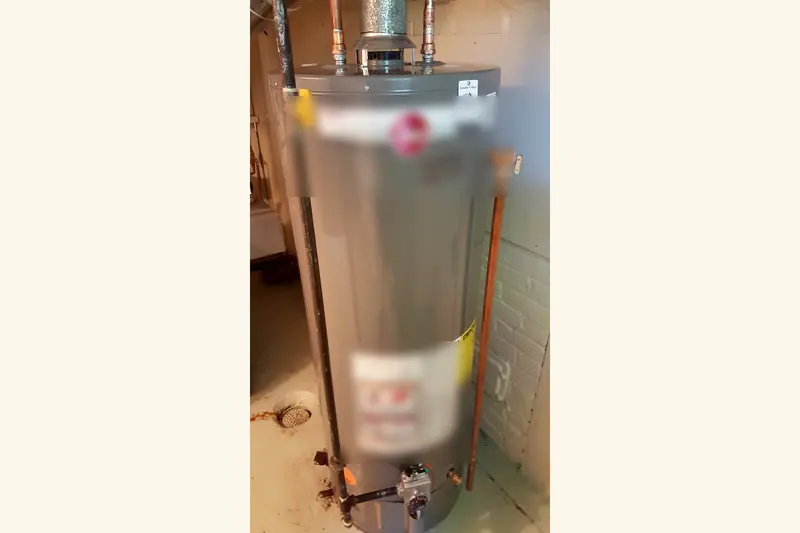
You can usually tell which you have by looking. Figure 22.2 shows a gas model. A heavy electrical cable and no vent pipe means electric. A vent rising from the top and a small pipe running to a control near the bottom means gas. The label on the tank will say.
22.4 Why does a tank wear out?
Water slowly attacks steel. The anode rod is there to be eaten first, and A. O. Smith's manual calls it a sacrificial rod that helps avoid corrosion and leaks in the tank.2 A water softener makes it wear faster.2 Once it is gone, the tank is next.
Minerals in the water also form sediment on the bottom. How much depends on the hardness of your water and the temperature setting, among other things.2 Heavy deposits can damage the heater and make it work harder for the same amount of hot water.2 We come to hardness itself in Chapter 34.
Water also grows when heated, and that extra volume must go somewhere. In many houses it cannot go back toward the street, so pressure in the pipes rises as the tank warms.2 This is one common reason a relief valve drips.
The U.S. Department of Energy's 2022 guide says most storage water heaters last 10 to 15 years.3 An old tank that begins to leak cannot be patched. Replacing a water heater is licensed work in this book, on either fuel.
22.5 What signs mean you should call someone?
Exhaust from a gas heater has to go up the vent. When it spills back into the room, it can bring carbon monoxide with it. The Pacific Northwest National Laboratory's guide for homeowners lists these signs: melted plastic washers on the nearby pipes, soot on the top of the tank, and a flue pipe that is disconnected or slopes the wrong way. It says to call a plumber to make repairs as soon as possible, and it recommends an alarm near the heater that warns of gas and carbon monoxide.4 You need only look for those signs. Leave the testing and the repairs to the plumber.
Two situations are not for looking at all. If you smell gas, leave the building first, without touching a light switch or using a phone inside. Call 911 and the gas utility from outside and well away, and stay out until they say it is safe.5 If a carbon monoxide alarm sounds, do the same: leave first, then call 911 from outside.
A. O. Smith's manual also says to keep flammable, corrosive and combustible materials away from its gas heaters.2 Paint cans and a laundry pile are the usual offenders, and moving them is one job here that takes no skill.
Where the line falls
- Yours to do
- Learning which fuel your heater uses; finding its label and manual; keeping stored things clear of it; putting a carbon monoxide alarm nearby as the alarm's instructions direct
- For a licensed pro
- Replacing the heater; every gas connection and vent; soot, melted washers or a loose flue; any leak from the tank itself
Notes
- U.S. Consumer Product Safety Commission, "Avoiding Tap Water Scalds." cpsc.gov ↩
- A. O. Smith, "Installation Instructions and Use & Care Guide, Residential Gas Water Heater." assets.hotwater.com ↩
- U.S. Department of Energy, "Energy Saver Guide" (2022). energy.gov ↩
- Pacific Northwest National Laboratory, Building America Solution Center, "Look for Signs of a Gas Water Heater Backdrafting." basc.pnnl.gov ↩
- Washington Utilities and Transportation Commission, "Pipeline Emergencies." utc.wa.gov ↩