Chapter Twenty-Three
The Right Temperature
By the editors of this book. Sources checked November 2, 2026.
The right water heater temperature setting for most homes is 120°F, the figure recommended by both the U.S. Consumer Product Safety Commission and the Department of Energy.1 2 It is hot enough for a shower and dishes, and far slower to burn than any hotter setting. Few numbers in this book matter more.
23.1 How fast does hot water burn?
Faster than you can get a child out of a tub. The CPSC gives these times for third-degree burns in most adults.1
| Water temperature | Exposure |
|---|---|
| 150°F | 2 seconds |
| 140°F | 6 seconds |
| 130°F | 30 seconds |
| 120°F | 5 minutes |
Look at the middle of that table. Going from 120°F to 130°F takes the margin from minutes to half a minute. The CPSC says most injuries and deaths from tap water scalds involve older people and children under five,1 who are the people least able to react or climb out.
A lower setting does not replace attention. The CPSC says never to take the water temperature for granted, to test it by hand before bathing a child, and not to leave a young child alone in the bathroom, even for a second.1
23.2 How do you measure the temperature at the tap?
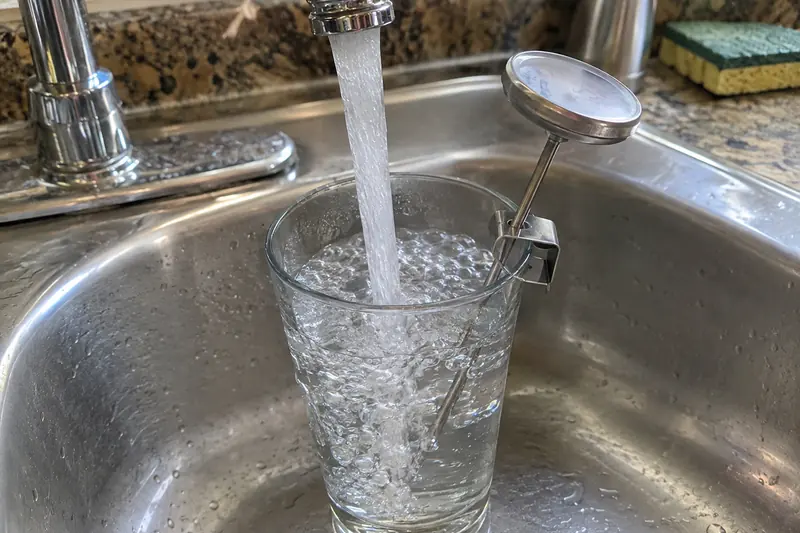
The dial on the heater is often only a rough guide, and many are not marked in degrees at all. Measure the water instead, as in Figure 23.1. All you need is a candy or meat thermometer.1
- Choose a time first thing in the morning, or at least two hours after anyone has used hot water.
- Turn on the hot water at a faucet and let it run until it stops getting warmer.
- Hold the thermometer in the stream with your hand out of the water, and read it.
- If the reading is above 120°F, have the setting changed as described below, then measure again on another morning.
23.3 How is the setting changed?
That depends on the fuel, so check the label first. Chapter 22 explains how to tell the two apart.
Electric heaters. The CPSC notes that the electric company may adjust the thermostat for you, and that some do it at no charge.1 Ask before you do anything else. The thermostats sit behind access panels, near live terminals, and most electric heaters have two that must be set alike.1 If you do it yourself, the breaker goes off before the panels come off and stays off until they are back on, and you follow the manual for your model. Anyone unsure should leave this to the utility or a professional. Any electrical work beyond that belongs to an electrician.
Gas heaters. Thermostats differ, and the CPSC says to call your gas company for instructions.1 The only other guidance this book gives is to follow the maker's printed label and manual for the control dial. If there is any smell of gas, do not touch the heater. If you smell gas, leave the building first, touching no switches and using no phone inside; call 911 and the gas utility from outside and well away, and stay out until they clear it.
Whichever fuel you have, allow time for a change to show up. A tank of hotter water has to be used and replaced before the new setting reaches the tap.
23.4 Why would anyone set it higher?
There is a real argument, and you should hear it. The Centers for Disease Control and Prevention says that keeping a home water heater between 130°F and 140°F can kill germs like Legionella, but that it also raises the risk of burns. It suggests asking your healthcare provider about your own risk of getting sick from Legionella, and whether a setting of 130°F or above is right for you.3
The CDC adds a condition. If you set a heater above 120°F, use valves that mix cold and hot water at the tap, called thermostatic valves, especially if young children, older adults or others at higher risk of burns live in the home.3 A hotter tank without those valves simply means hotter faucets.
So our recommendation stays at 120°F, the CPSC and Department of Energy figure.1 2 If a doctor has given you a reason to go higher, have a plumber fit thermostatic valves first and raise the setting after. This book will not advise you beyond that on the health question.
23.5 What about the dishwasher?
People often keep a tank hotter for the dishes. The Department of Energy's 2022 guide says that if your dishwasher has an internal element that boosts the water temperature, you can set the water heater to 120°F, and it tells you to check the dishwasher's manual for your model.2 Hookups for dishwashers are covered in Chapter 11.
23.6 What does a thermostatic valve do?
It blends hot and cold water at a set point before the water reaches you, and it holds the blend steady as supply conditions change. It can sit under a sink or be built into a shower control. Chapter 10 covers the shower version.
These valves fail in their own way. A. O. Smith's manual points out that a worn mixing valve can make hot water seem not warm enough, because the fault is at the fixture and not in the tank.4 That is worth remembering before you blame the heater.
If you want to see the kinds available before speaking to a plumber, PlumbingSupplyAndMore's mixing valves section (PlumbingSupplyAndMore has the same owners as this book) is one place to look, and not the only one. Fitting one means working in the supply lines and setting the outlet temperature correctly, so in this book it goes to a licensed plumber.
Where the line falls
- Yours to do
- Measuring water at the tap with a thermometer; hand-testing a bath; asking the electric or gas company about the setting; with the breaker off and the manual open, adjusting an electric thermostat if you are confident of it
- For a licensed pro
- Installing thermostatic mixing valves; any control work on a gas heater beyond what the printed label directs; a heater that runs hotter than its setting
Notes
- U.S. Consumer Product Safety Commission, "Avoiding Tap Water Scalds." cpsc.gov ↩
- U.S. Department of Energy, "Energy Saver Guide" (2022). energy.gov ↩
- Centers for Disease Control and Prevention, "Preventing Waterborne Germs at Home." cdc.gov ↩
- A. O. Smith, "Installation Instructions and Use & Care Guide, Residential Gas Water Heater." assets.hotwater.com ↩