Chapter Eleven
Washers, Dishwashers, Icemakers
Part Two: Faucets and Fixtures
By the editors of this book. Sources checked November 2, 2026.
Washing machine shut off valves are the two small valves in the box or on the wall behind the washer, one hot and one cold, and they should be easy to reach and able to close. Those valves and the hoses after them see full house pressure all day. A dishwasher and an icemaker have thinner lines with a similar risk, and all three are easy to look after.
11.1 What is in the box behind the washer?
Most newer houses have a recessed outlet box like the one in Figure 11.1, with hot and cold valves side by side and a drain opening. Hot is usually on the left, marked in red, though this is a convention and not a promise. Older houses may have two plain hose faucets on a pipe, or a single lever that closes both at once.
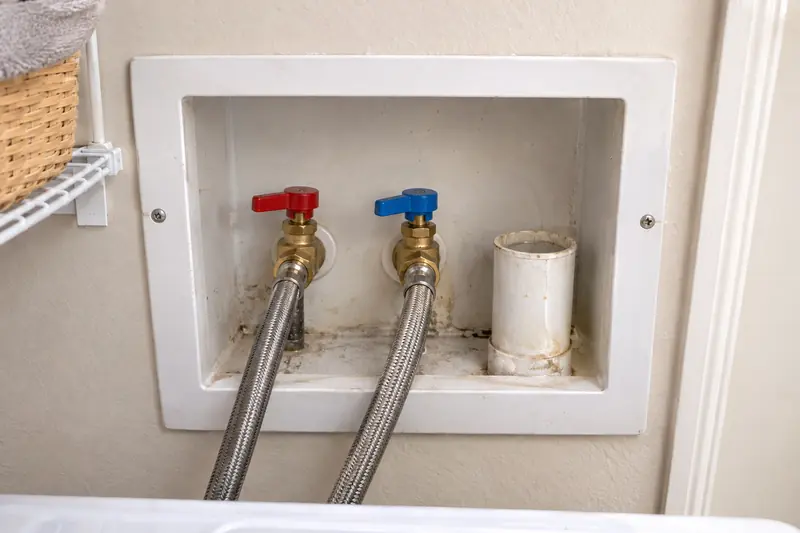
The drain side is simple. The washer's gray hose hooks into a pipe called a standpipe, with a trap below it just like a sink's. Chapter 5 explains the trap. If a standpipe overflows when the washer pumps out, the line may be clogged or too small, and you can try Chapter 16 before calling anyone.
11.2 How often should you replace washer hoses?
On a five-year schedule. GE Appliances recommends replacing hoses every 5 years or when you install a new washer, to help avoid leaking or flooding.1 Put the date on the hose with a permanent marker when you do it, because nobody remembers.
Look at them more often than that, once or twice a year. Pull the machine out and check for bulges, cracks, rust at the crimps and any dampness at the ends. Replace them at once if you find any of those, whatever their age. A hose that lets go when no one is home runs at full flow until someone finds it. Check too that the hose is not pressed against the wall and kinked behind the machine, because that weakens it over time.
Braided hoses cost a bit more, and many owners prefer them. Replacement washer valves and braided lines are listed in PlumbingSupplyAndMore's washing machine valve section (PlumbingSupplyAndMore has the same owners as this book) and its braided supply lines section (PlumbingSupplyAndMore has the same owners as this book), which are places to look, not the only or best ones. Check that any braided line you buy is rated for washer use, since a sink connector may be too short or too small.
- Close both washer valves, and unplug the machine.
- Set a bucket underneath, and unscrew each hose at the wall first and then at the machine.
- Drain the old hoses into the bucket.
- Fit the new rubber washers that come with the new hoses, one in each end.
- Thread the new hoses on, hot to hot and cold to cold, hand-tight, then a quarter turn with pliers.
- Open the valves slowly, and check for drips at both ends with a dry hand.
- Push the machine back without kinking the hoses.
11.3 What about a valve that leaks or will not close?
Old washer valves are often the plain kind that take several turns, and they can stick. Try them gently, as you would the others in Chapter 6. If one weeps at the stem, a snug on the packing nut may be enough. To replace a threaded valve, you close the main and use two wrenches, one to hold the pipe still. A soldered one, or one inside a wall box, is usually work for a plumber.
A loud bang when the washer's own valves snap shut is water hammer, and it is often worse at high pressure. See Chapter 31.
11.4 How is a dishwasher connected?
A dishwasher takes a single supply line, usually from the hot stop under the kitchen sink, and has a drain hose that runs to the sink's drain or to the disposer. A separate stop for it is a convenience worth having. DOE notes that a dishwasher with an internal booster heater lets you set your water heater at 120°F, so there is no need to raise the heater for its sake.2
The drain hose matters more than it looks. Dirty water in the sink must not be able to find its way back into the machine. Whirlpool's guidance is that the drain loop should ideally be at least 20 inches off the floor, and that an air gap should be used if it is under that.3 Your town may require an air gap whatever the loop height, so check with your local building department when you are installing a new one. A hose that has sagged to the cabinet floor is easy to lift and fasten up again.
Replacing a dishwasher is mostly plumbing you can do, with one part that belongs to the electrical side. Turn the breaker off before you touch the wiring, and if the connection is not a plain plug, ask an electrician to do it.
11.5 How should an icemaker line be connected?
A refrigerator line carries cold water in a narrow tube, and it runs behind an appliance you may not move for ten years. That makes it a quiet source of damage. A slow drip from a saddle fitting can soak a floor before anyone notices.
Whirlpool's instructions say not to use a piercing-type or 3/16 inch saddle valve, which reduce flow and clog more easily. They call for a 1/4 inch type of valve that needs a drilled hole, connected with 1/4 inch outside-diameter soft copper or PEX tubing, and they ask you to confirm that a saddle-type valve meets your local plumbing codes.4 Plenty of old installations use the piercing type. If you have one and want it gone, a plumber can fit a proper shutoff on the cold line.
Pull the refrigerator out once a year to check the line. If you find a stain, follow it back. Chapter 28 shows how to use your meter if you suspect water you cannot see.
11.6 What about gas dryers, gas ranges and the rest?
A laundry room often has a gas line for the dryer. Moving, adding or reconnecting gas is licensed work, and it stays that way even when the job sits in the same closet as a pair of water hoses you can change yourself. If you smell gas, leave the building first, touching no switches and using no phone inside; call 911 and the gas utility from outside and well away, and stay out until they clear it.5
Where the line falls
- Yours to do
- Replacing washer hoses and rubber washers; dating and inspecting hoses; closing washer valves when away; raising a sagging dishwasher hose; checking the icemaker line
- For a licensed pro
- Gas dryer and range connections; soldered or in-wall washer valves; a new shutoff tapped into the cold line for an icemaker; new supply or drain lines to a laundry; wiring beyond a breaker and plug
Notes
- GE Appliances, "Washer: Stainless Steel Inlet Fill Hoses." products.geappliances.com ↩
- U.S. Department of Energy, "Energy Saver Guide" (2022). energy.gov ↩
- Whirlpool, "Checking the Drain Loop Height." producthelp.whirlpool.com ↩
- Whirlpool, "How to Check the Water Supply Line." producthelp.whirlpool.com ↩
- Washington Utilities and Transportation Commission, "Pipeline Emergencies." utc.wa.gov ↩