Chapter Five
Traps and Vents
By the editors of this book. Sources checked November 2, 2026.
A P-trap holds a small plug of water that stops sewer gas from entering the room, and a plumbing vent lets in air so that draining water does not suck that plug out. They work as a pair. Between them they explain most gurgling drains and a good share of bad smells in a house.
5.1 What does a trap actually do?
Sewer pipes contain gas. Wisconsin's health department describes sewer gas as a mix of toxic and nontoxic gases formed as waste decays, with hydrogen sulfide and ammonia among the most toxic.1 Something has to stand between that gas and your bathroom, and a trap does it with nothing more than water sitting in a bend.
When a fixture drains, water flows through the bend and carries on. The last of it stays behind and fills the low point, forming the seal. It is a simple part with no moving pieces. Figure 5.1 shows it in section.
How deep should the seal be? One federal example is the manufactured-home standard, which calls for a water seal of not less than 2 inches and not more than 4 inches.2 It is the rule for manufactured homes, and your local code sets its own numbers, but it gives you an idea of how little water stands between your house and its sewer.
5.2 Why do traps run dry?
A trap that is not used slowly loses its water to evaporation. Guest baths, basement floor drains and that shower nobody uses are the usual suspects. Illinois's health department notes that dry traps can let sewer gas in, and Wisconsin's advice is to run water into floor and sink drains so the traps do not dry out.3 1
The cure is about as cheap as cures get. Run the tap for half a minute in each unused fixture, say once a month, and pour a pitcher into any floor drain. Chapter 19 goes through the other causes of a smell, and it is the chapter to read if pouring water does not end it.
Strong sewage smell is another matter. If the smell is strong, or anyone has a headache, dizziness or nausea, get out and call the fire department from outside. Avoid sparks and flames.1
5.3 What does a vent do?
Picture a full soda bottle turned over. It glugs, because air has to get in as water comes out. A drain behaves the same way. Water moving down a pipe pushes air ahead of it and leaves a low pressure behind it, and if no air can get in from somewhere, it will pull from the nearest available source, the water in a trap.
A vent gives it a better source. Each trap connects, a short way downstream, to a pipe that rises through the house and opens above the roof. As Figure 5.2 shows, air comes down from the Roof vent and follows the water. The same pipe lets sewer gas rise and leave high above anyone's window.
The manufactured-home standard states it in six words: all traps shall be effectively vented.2 Local codes have their own requirements, including whether some kinds of mechanical vent are allowed.
5.4 How do you tell a vent is in trouble?
A blocked or missing vent has a recognizable set of symptoms. A sink gurgles after it empties. A toilet bowl's water level shifts when another fixture drains. A bathtub glugs when the washer pumps out. A smell comes and goes, especially just after heavy water use, because a trap is being partly pulled empty each time.
Wisconsin suggests occasionally checking the roof vent for debris such as leaves or bird nests.1 You can often see the opening from the ground or an upper window. If you cannot, ask someone who is used to working on roofs. It is not worth a ladder and a fall to save a service call. Anything beyond looking, including changing how a vent runs, belongs to a licensed plumber.
A gurgling drain can also be partly blocked, so try Chapter 16 first. If a slow drain improves but the gurgle remains, the vent is the likelier cause.
5.5 What about the shape and the arm?
The pipe leaving the trap, the trap arm, has a job too. The manufactured-home rule grades it 1/4 inch per foot toward the vent, and it also says it should have no greater slope than its diameter.2 Too much drop and the water falling away can pull the seal with it, so a neat-looking trap set too high on the wall is not neat at all. Again, your local code sets the figure for your house.
The same rule prohibits S-traps, in which the outlet turns straight down instead of running out to a vent, along with drum traps, bell traps and a few other old designs.2 You may well find an S-trap in an older house. If it is not giving trouble, it can wait until a remodel. Turning one into a P-trap usually means adding a vent in the wall, which is a plumber's work.
5.6 Can you replace a trap yourself?
Yes. A sink trap is about the most forgiving job in plumbing, because it is held on by hand-tight or lightly wrenched slip nuts and it is not under pressure. Chapter 17 gives the steps. The chrome trap in Figure 5.3 is the kind you often see under a pedestal sink, where it is on display. Plastic ones under a kitchen sink do the same job.
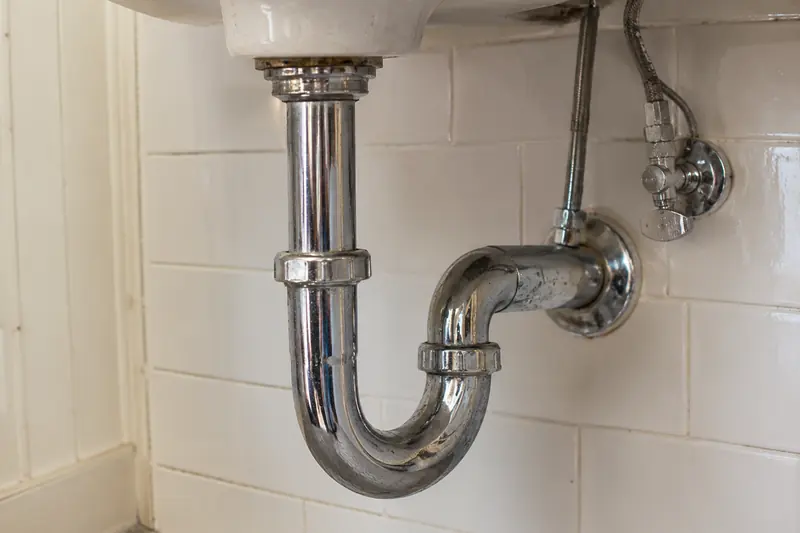
Replacement traps are listed in PlumbingSupplyAndMore's traps section (PlumbingSupplyAndMore has the same owners as this book). It is one place to look, not the best. Match the size of the tailpiece coming down from the sink before you buy.
Where the line falls
- Yours to do
- Running water into unused drains; looking at the roof vent from a safe spot; taking off, cleaning and replacing a sink trap; tightening slip nuts
- For a licensed pro
- Clearing a blocked vent from the roof; adding, moving or changing a vent; converting an S-trap; anything that opens a wall to reach a drain
Notes
- Wisconsin Department of Health Services, "Sewer Gas." dhs.wisconsin.gov ↩
- Legal Information Institute, Cornell Law School, "24 CFR 3280.606, Traps and Cleanouts." law.cornell.edu ↩
- Illinois Department of Public Health, "Hydrogen Sulfide Gas." dph.illinois.gov ↩