Chapter Four
How Drains Work
By the editors of this book. Sources checked November 2, 2026.
Drains work by gravity alone: each pipe slopes gently downhill, often about 1/4 inch per foot, and water carries waste along it toward the sewer or septic tank. No pump or pressure is involved in an ordinary house. That simplicity is why the system can run for generations, and why a small error in its slope can cause a lifetime of clogs.
4.1 What is fall, and how much does a drain need?
Fall is the amount a pipe drops over its length. A plumber might also call it pitch, slope or grade, and they all mean the same thing. It is the single most important thing about a drain, because a level pipe does not drain so much as hold water and whatever is in it.
The figure you will usually hear is 1/4 inch of fall per foot of pipe. As one federal example, the manufactured-home standard calls for at least that much on horizontal drains, and allows 1/8 inch per foot where the 1/4 inch is impractical and a full-size cleanout is fitted at the upper end.1 That is a rule for manufactured homes; your local code sets the numbers for your house. Do the arithmetic and a 20-foot run at 1/4 inch per foot drops 5 inches, which is why long runs eat up basement headroom and why low fixtures sometimes need pumps.
As Figure 4.1 shows, the slope is too slight to see from across a room. You can check an exposed length of pipe with a small level. On a 2-foot level held along a horizontal drain, about 1/4 inch per foot means the bubble sits clearly off center, toward the high end of the pipe.
4.2 What does a drain do with solid waste?
Solids do not slide along on their own. They are carried, in a brief flush of water that moves as a sort of slug down the pipe. A toilet supplies a good one. So does a full bathtub.
Modern low-flow fixtures use less water for each flush: the federal standard for toilets is 1.6 gallons per flush and WaterSense models use 1.28 or less, where old models used as much as 6.2 In a well-pitched system this causes no trouble, and Chapter 12 covers how a modern bowl makes up the difference. On a flat or sagging old line, there may be less water to push things along, so it is one more reason to learn your drains before blaming the toilet.
4.3 From fixture to street
A small branch, often 1 1/4 inch to 2 inches across, leaves each fixture, passing through its trap. Branches join into larger horizontal runs under the floor, and those meet a vertical stack. The stack drops down through the house, usually in a wall behind a bathroom, and at the bottom it turns into the building drain, the main line leaving the house.
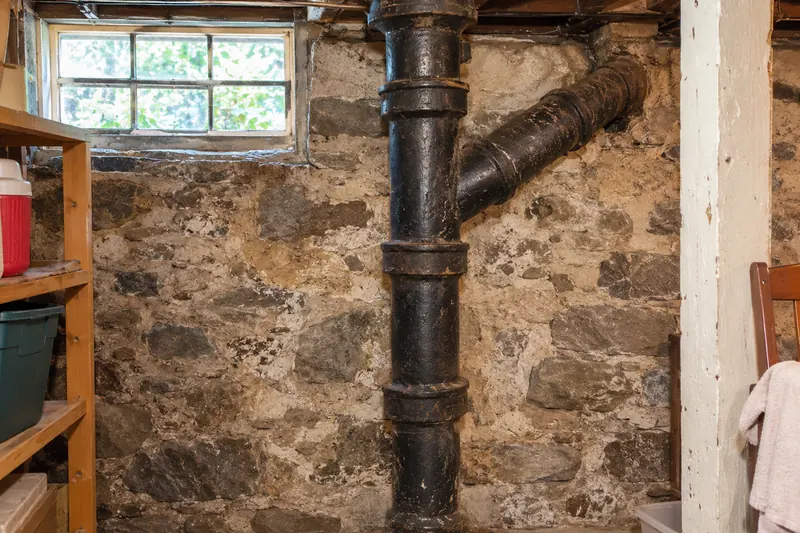
In older homes, as in Figure 4.2, the stack may be cast iron. It has a heavy, dull look and a dark, rough surface. It is quiet, it is strong, and when old it can be fragile at the joints. Newer houses mostly use plastic, and many old houses are a mixture of both, joined with rubber couplings.
Beyond the foundation the pipe is called a sewer lateral, and it runs to the city main or to a septic tank. Who owns the lateral depends on your city, as Chapter 20 explains. It is not a homeowner's dig.
4.4 Why does a drain run slowly?
Most slow drains have nothing to do with slope. They are caused by hair and soap near the top of the line, and Chapter 16 is the first place to go. Only one fixture slow means the trouble is in that fixture's branch.
Several fixtures slowing together suggests the trouble is farther down, in a shared line, and all of them at once suggests the main. The sequence often helps: if a toilet gurgles when the washer drains, or a tub backs up when a toilet is flushed, water is looking for a way around something. Stop using water and read Chapter 20.
A run that clogs over and over in the same place may have a real slope problem, usually a hanger that has let go or a section someone installed flat. A plumber can put a camera down the line and show you, and the repair, if one is needed, is theirs. If the drain gurgles without clogging, the vent is a better suspect than the fall, and that is the next chapter's subject.
4.5 Is any of this your job?
Mostly you only need to watch it. Look along exposed drains once a year or so, and notice whether any section has sagged, whether a hanger has come loose, or whether a joint has stains beneath it. Notice whether water pools in any fixture for longer than it used to.
4.6 What should never go down the drain?
A gravity system has no force to shove a clog through, so what you put in it matters. Cooking grease is the classic trouble, since it cools and clings as it goes. A home on a septic system has stricter rules still. EPA says only human waste and toilet paper belong in the toilet, and never to pour cooking oil or grease down a drain.3 Chapter 21 lists the rest.
Fix a slow drain mechanically before you think about a bottle of chemical. Chapter 18 explains why.
Where the line falls
- Yours to do
- Checking exposed drains with a level; noting sagging hangers and stains; finding your cleanouts; clearing a single fixture with a plunger or hand snake
- For a licensed pro
- Regrading or rehanging drain runs; cast iron and stack repairs; camera inspections; anything from the foundation out to the sewer or tank