Chapter Twelve
How a Toilet Works
By the editors of this book. Sources checked November 2, 2026.
A toilet works by dumping a tank of stored water into the bowl fast enough to start a siphon, which pulls the bowl's contents down the drain. There is no pump and, in an ordinary house toilet, no electricity. Gravity does the work, and a few cheap parts in the tank put the water back for next time. Once you know those parts, most toilet faults stop being mysterious.
12.1 What happens in the few seconds of a flush?
Look at Figure 12.1 and follow the water. You push the handle. It lifts the chain, the chain lifts the flapper, and the flapper uncovers the flush valve, a wide hole in the floor of the tank. The water in the tank falls through that hole all at once.
Some of the water runs out through the rim holes under the lip of the bowl and rinses the sides. The rest pushes straight into the bowl and raises the level until water spills over the high point of the trapway. Once the trapway runs full, the falling water on the far side pulls the bowl after it. That is the siphon, and the gulp at the end of a flush is air breaking it.
As the tank empties, the flapper drops back onto the flush valve and seals it. Nothing else has to happen for the flush to be over. The rest of the cycle is refilling.
12.2 How does the tank fill back up?
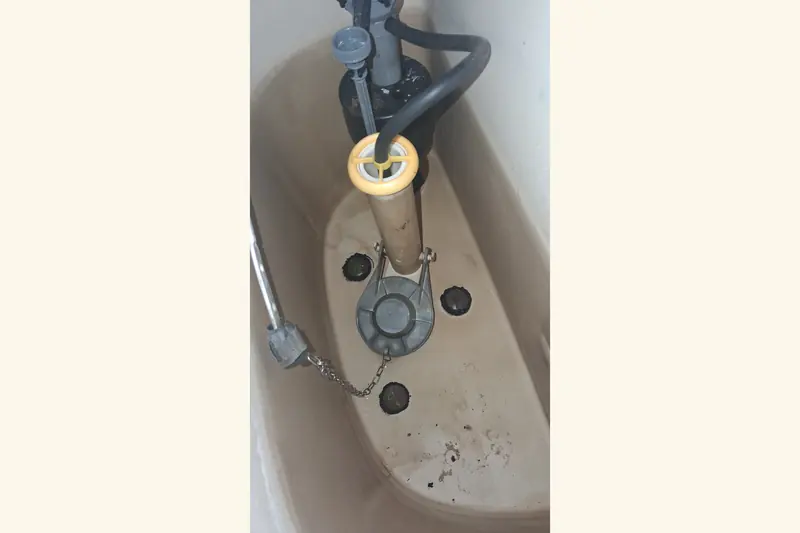
The fill valve is the tall part at one side of the tank, connected underneath to the supply line. It is held shut by the float. When the water level falls, the float falls with it and the fill valve opens. When the level comes back up, the float rises and closes the valve again.
While it fills the tank, the fill valve also sends a small stream through the refill tube, a thin hose clipped to the top of the overflow tube. That stream runs down the overflow tube and into the bowl, and it is what restores the water standing in the bowl after the siphon has emptied it. If the refill tube slips off its clip, the bowl may sit low after a flush while the tank fills normally.
The overflow tube is the safety. It is the open pipe standing up in the middle of the tank, and it leads into the bowl. If the fill valve ever fails to close, water spills down the overflow tube and into the bowl instead of over the rim of the tank. Fluidmaster's instructions for one common fill valve recommend a water level 1/2 inch below the top of the overflow tube.1 That margin is why a running toilet is usually a nuisance and not a flood.
Figure 12.2 shows how little is in there. A lid, a tank of clean supply water, and a handful of parts that lift out and go back in with ordinary tools.
12.3 Why does the bowl always hold water?
The water standing in the bowl is the water seal, and it does the same job as the trap under a sink, which we met in Chapter 5. It blocks the air of the drain pipes from coming into the room. A toilet is a trap with a seat on it. The trap is simply cast into the china, which is why you cannot see a separate curved pipe behind the bowl.
This explains two things that puzzle people. A toilet in an unused bathroom can eventually start to smell, because the seal slowly evaporates, a problem we return to in Chapter 19. And a toilet that loses its seal after a flush, or whose water level bobs when another fixture drains, may have a blocked drain or vent, not a bad toilet.
12.4 How much water does a flush use?
Less than it used to. The federal standard for new toilets is 1.6 gallons per flush, WaterSense labeled models use 1.28 gallons or less, and old models can use as much as 6.2 EPA says switching from an old model can save a household nearly 13,000 gallons a year, and more than $170 a year.2
People who remember the first low-flow toilets may doubt this. EPA addresses that directly: the early low-flow models of the 1990s were sometimes linked with performance problems, and EPA says the WaterSense models designed and sold today far outperform the traditional toilets of the 1980s and 1990s.2 If you have an older toilet that clogs often, the cause may be its age and not the amount of water.
| Part | Its job | When it fails |
|---|---|---|
| Flapper | Holds water in the tank until the flush | Water trickles into the bowl; the tank refills by itself |
| Chain | Lifts the flapper | Too tight, the flapper will not seal; too loose, it can tangle under the flapper |
| Fill valve | Refills the tank, then shuts | Hissing that does not stop |
| Float | Tells the fill valve when to shut | Water level too high or too low |
| Refill tube | Tops up the bowl | Bowl sits low after a flush |
| Overflow tube | Safety drain for a high tank | Water running into it means the level is set too high |
| Trapway | Carries the flush away and holds the seal | Slow or blocked flush |
12.5 What should not go in the tank?
Fluidmaster warns against drop-in tank cleaners that contain bleach or chlorine, saying they damage tank components and may cause flooding.1 That is a maker speaking of its own parts, and it is reason enough to read the warning on whatever you buy. A tank does not need cleaning products to do its job.
Anything else in the tank should be there on purpose. A brick or a bottle put in years ago to save water takes room from the flush and can get in the way of the flapper. Take it out, and if you want a smaller flush, replace the toilet.
12.6 Which faults belong to which chapter?
Everything in the tank is ordinary homeowner work, and Chapter 13 walks through the two parts you are most likely to change. A blocked bowl is in Chapter 14. Water around the base, or a toilet that rocks, is a seal problem and is in Chapter 15. The words used here are collected in the glossary.
Where the line falls
- Yours to do
- Taking the tank lid off and watching a flush; adjusting the chain and the float; reclipping the refill tube; choosing a lower-flow toilet
- For a licensed pro
- A cracked tank or bowl you would rather not lift; a toilet whose water level moves when other fixtures drain, which points to the drain or vent
Notes
- Fluidmaster, "400A Fill Valve Installation Instructions." fluidmaster.com ↩
- U.S. EPA WaterSense, "Residential Toilets." epa.gov ↩