Chapter Fourteen
The Toilet That Will Not Clear
By the editors of this book. Sources checked November 2, 2026.
To unclog a toilet, keep the water from rising, then use a flange plunger with slow, firm strokes, and move on to a toilet auger if that fails. Most clogs sit in the trapway, a few inches from where you are standing. Do not flush again to see if it has cleared. That second flush is how a clog becomes a mess on the floor.
14.1 The bowl is rising: what do you do first?
You have a few seconds, and two ways to use them. The fastest is to lift the tank lid and push the flapper down with your hand, which stops water entering the bowl. The surer one is to close the fixture stop on the supply line, turning it clockwise. Chapter 12 shows why either works: the bowl only rises while the tank is emptying.
Then wait. A bowl that has risen will usually drop back slowly as water seeps past the clog, and you will plunge far more cleanly with the level lower.
If water has reached the floor and is spreading toward an outlet, a power strip or an appliance, do not walk through it. Use the breaker only if you can reach the panel from a dry spot. Otherwise call the utility or the fire department from outside.
14.2 Which plunger?
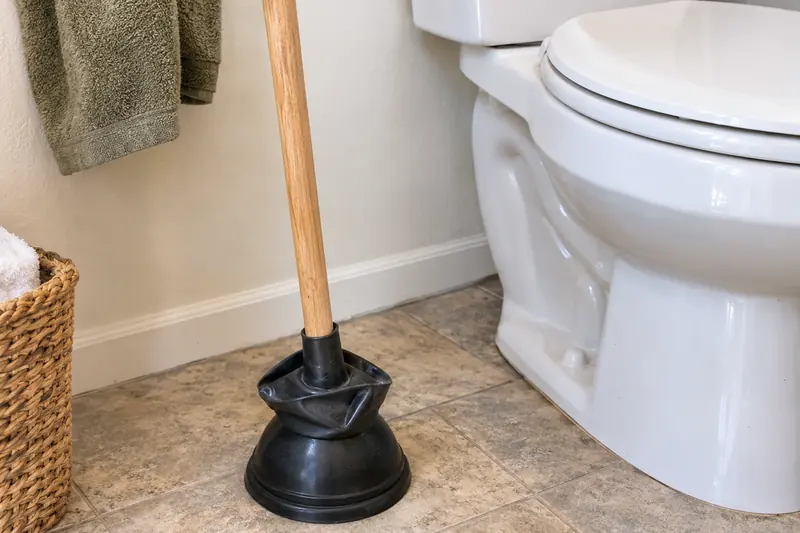
There are two common shapes, and only one suits a toilet. A cup plunger has a flat rubber dome and is made for flat surfaces such as a sink. A flange plunger, in Figure 14.1, has a soft sleeve that folds out from inside the cup and fits into the outlet of the bowl. That fit is the whole point, because a plunger works by moving water back and forth and needs a seal to do it.
- Put on rubber gloves, and lay old towels around the base.
- Make sure there is enough water in the bowl to cover the cup. If not, add some from a bucket.
- Fold the sleeve out and fit it into the outlet at the bottom of the bowl.
- Push down gently the first time, because the cup is full of air and the first push can splash.
- Pump 15 or 20 times, firmly on the way down and as firmly on the way up.
- Break the seal and watch. If the water drops with a rush, the clog has moved.
- Open the stop and flush once, with your hand ready to lower the flapper.
Repeat the set two or three times before you give up on the plunger. The pull matters as much as the push, because a wad of paper is often loosened by being drawn back and forth, not rammed further in.
14.3 When does a toilet auger make sense?
When the plunger has had a fair chance and the water still will not drop, or when something solid has gone down: a toy, a bottle cap, a toothbrush. A plunger can seat a solid object more tightly. A toilet auger is a short hand-cranked snake built for this job, with a rubber sleeve over the bend that protects the china from scratches.
- Pull the cable back into the tube so only the tip shows.
- Set the sleeved end in the outlet of the bowl with the bend pointing up the trapway.
- Push the handle down slowly while you crank.
- Stop when you feel it catch or stop advancing, and crank a little more.
- Draw the cable back while still cranking, so that whatever it has caught comes with it.
- Flush once to test, then rinse the auger into the bowl and clean it outside.
An auger is not the same tool as the snake used in Chapter 16. A sink snake's bare cable can leave marks on a bowl and is the wrong shape for the trapway.
14.4 What about hot water, soap and chemicals?
Leave chemical drain cleaners out of it. Chapter 18 sets out why, but the short form is that a bowl full of standing chemical is what you would then have to plunge, and you must never plunge or snake after pouring one. This book also does not recommend pouring boiling water in a toilet bowl. There is little to gain, and a splash can scald.
What goes into a toilet matters more than what you put in to fix it. EPA's rule of thumb is written for septic owners, and it serves anyone: flush nothing but human waste and toilet paper.1 Its list of things that should never go down includes wipes, diapers, cooking grease and coffee grounds.1 Wipes sold as flushable are a reasonable thing to doubt, whatever the package says.
If you have an old toilet, it may be part of the trouble. EPA says old designs of the 1980s and 1990s are far outperformed by the WaterSense models sold today, which use 1.28 gallons or less per flush.2
14.5 Is it really the toilet?
Check another fixture before you pull out more tools. If the tub gurgles when you flush, if a sink downstairs is backing up too, or if the shower drain fills when the washer empties, then the clog is not in this toilet at all. It is in the line they all share, and no amount of plunging here will reach it. Stop running water and go to Chapter 20.
If sewage has backed up into the room, the rules change. EPA's advice is to avoid contact, since it can contain harmful pathogens, and to ask your local health department for guidance.3 Dirty water from a bowl you just plunged is a small cleaning job with gloves and disinfectant. Sewage across a floor is different. Where sewage has caused water damage, EPA says to call in a professional with experience in buildings damaged by contaminated water.4 The by-problem index lists the related faults.
14.6 When do you lift the toilet?
Sometimes the only way to get an object out is from behind, which means taking the toilet off the floor. That is the same job as changing the wax ring, so read Chapter 15 and buy a new ring first, because the old one cannot go back on. Many owners call a plumber at this point, and it is a fair place to stop.
Where the line falls
- Yours to do
- Plunging with a flange plunger; running a toilet auger; closing the stop; cleaning up a small overflow
- For a licensed pro
- Repeat clogs after an honest auger attempt; an object that only comes out with the toilet removed, if you prefer not to lift it; any backup that shows up at other fixtures