Chapter Sixteen
Clearing a Slow Drain
By the editors of this book. Sources checked November 2, 2026.
To unclog a drain, start with a plunger, move to a hand snake, and take off the trap only if those fail. Chemicals are not on that list, for reasons given in Chapter 18. Most slow drains are blocked within arm's reach of the fixture, by hair in a bathroom and by grease in a kitchen. Those are ordinary homeowner jobs.
16.1 Is the clog here, or further down?
Spend a minute on this before you pick up a tool. Run water in the fixture next door. If one sink is slow and everything else is fine, the clog is in that sink's own branch, and this chapter applies. If the tub gurgles when the toilet flushes, or two or more fixtures are slow together, the clog is in a pipe they share.
The lowest fixtures in the house tell you the most. A basement floor drain or a ground-floor shower that fills when something upstairs drains is a warning, and Chapter 20 is where you should go next. Nothing in this chapter reaches that far, and running more water only makes it worse.
There is one other question to ask. Has anyone poured anything down this drain today? If a chemical has gone in and the drain is still blocked, stop here. You must not plunge or snake it. Turn to Chapter 18 first and tell whoever comes what the product was.
16.2 Start with what you can see
Many slow bathroom drains are not clogged in the pipe at all. The stopper is holding a mat of hair. Most sink pop-ups lift out or come free when you undo a small nut on the rod behind the drain, under the sink. Many tub stoppers lift out or unscrew. Pull it, clean it, and test the drain before doing anything else.
A kitchen strainer basket works the same way. If the sink has a disposal, run it with cold water, because a full disposal can look like a clog. Never put a hand in it. Clearing a disposal's jam is a job for its manual, with the power off.
16.3 Plunging a sink or tub
Use a cup plunger, the flat kind, on a sink or tub. It is the wrong tool for a toilet, as Chapter 14 explains, for the same reason it is the right tool here. The rim sits flat and seals. A plunger moves water in both directions, so air escaping elsewhere takes the force out of it, which is why the second opening must be blocked.
- Take out the stopper or strainer.
- Stuff a wet rag tightly in the overflow opening, or in the other basin's drain on a double sink. Have a helper hold it if the sink is a double.
- Run 2 or 3 inches of water, enough to cover the rim of the cup.
- Set the plunger over the drain and press out most of the air.
- Pump straight up and down 15 or 20 times, keeping the rim on the surface.
- Pull it off with a final sharp lift, and watch the water.
- Run hot tap water for a minute to carry away what you loosened.
If the sink shares a drain with a dishwasher, the plunged water can push toward the hose. Keep an eye on it, and read the machine's manual if the dishwasher has backed up.
16.4 Running a hand snake
A hand snake, also called a hand auger or drain cleaner, is a coil of flexible steel cable in a drum with a crank, as in Figure 16.1. It reaches further than a plunger does and it can pull out what a plunger only pushes around. You can often feed it down through a sink drain once the stopper is out, but the bends in a trap can stop it. If so, take the trap off, as in Chapter 17, and feed it into the pipe in the wall.
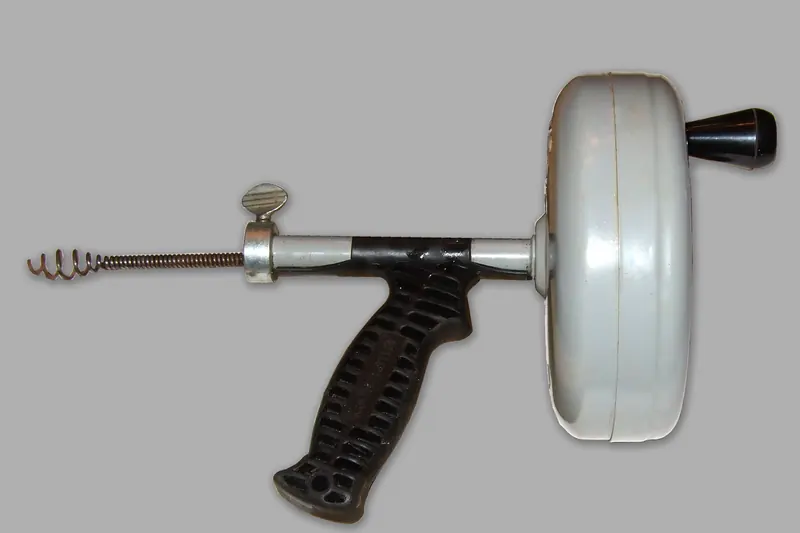
- Put on rubber gloves and eye protection, and lay a towel under the work.
- Pull out a foot or so of cable and feed the tip into the drain.
- Tighten the thumbscrew so the cable turns with the drum.
- Crank steadily while pushing the cable forward with light pressure.
- Loosen, pull out another foot, tighten, and repeat as the cable goes in.
- When you feel the cable stiffen or stop, crank a few turns in place.
- Draw the cable slowly out, still cranking the same way, and bring the catch up with it.
- Wipe down the cable as it returns, and run water to test the drain.
Keep the cable from buckling, because a coil that bends sharply can kink. Do not force it hard around a bend, and watch old thin fittings. If you meet something solid after 10 or 15 feet that will not move, stop, as a hand snake has reached its limit.
16.5 What about boiling water?
EPA's advice for a clogged drain on a septic system is to avoid chemical openers and to use boiling water or a drain snake instead.1 That is the only place the book would reach for it. Boiling water can soften a plastic trap or crack a china basin, and it is a scald waiting to happen, as Chapter 23 makes clear. If you use it at all, use it on a metal sink and a metal trap. Carry the kettle with both hands, pour slowly from close above the drain, and keep children and pets out of the room.
Do not pour it into a drain that has had a chemical in it, or on top of standing water full of something you cannot identify. Do not use it in place of finding out what is wrong.
16.6 Which clogs come back, and why?
The usual cause in a kitchen is grease, which runs down warm and sets in the pipe. EPA tells septic owners never to pour cooking oil or grease down the drain, and sewer owners have no better reason to.1 Wipe pans out with a paper towel, and put the grease in the trash. In a bathroom, a strainer that catches hair is worth having, and a few minutes of cleaning every month or two prevents the next clog.
Sometimes a drain gurgles or runs slow even when nothing is in it. That is air, not a clog, and a vent problem of the kind described in Chapter 5. If you have snaked a drain clean and it still behaves oddly, this is the likely reason. The by-problem index sorts these symptoms, too.
A last word on products. Whatever you use, use one thing. New Jersey's health department warns that mixing bleach with drain openers, ammonia or acids can release toxic gases, and that different brands of drain cleaners can react dangerously when combined.2 If you splash any cleaner, the first aid is in Chapter 18.3
Where the line falls
- Yours to do
- Pulling and cleaning stoppers; plunging a sink or tub; running a hand snake; keeping grease and hair out of the pipe
- For a licensed pro
- A clog beyond 15 feet or so of hand snake; power rodding of any kind; two or more fixtures slow at once; any drain that has had chemical poured in it and is still blocked