Chapter Twenty
When Every Drain Backs Up
By the editors of this book. Sources checked November 2, 2026.
A main sewer line clog is the likely cause when every drain backs up at once, and your first moves are to stop using water and, where your city asks for it, call the city before a plumber. This is not a plunger job. The blockage is somewhere past the point where your fixtures join, possibly under the yard or the street. Your part is to keep sewage out of the house, keep yourself out of the sewage, and find out who is responsible for the pipe.
20.1 How do you know it is the main line?
One slow sink is a local clog, and Chapter 16 deals with it. A main line problem shows up across fixtures, usually from the bottom of the house up, because a backed-up pipe fills from its lowest openings first.
These are the usual signs. A basement floor drain or a ground-floor shower fills with dirty water. A toilet bubbles or rises when the washer empties, or a tub drain gurgles when a toilet flushes. Several fixtures on different branches go slow together. Livermore's city page describes the same thing in one line: toilets, tubs and other drains draining slowly or stopped.1
20.2 What do you do in the first few minutes?
The pipe will not hold more than it holds. Every gallon you send into it comes up somewhere.
- Stop running water, and ask everyone in the house to do the same.
- Turn off the washer and dishwasher if either is running, and do not start them.
- Do not flush, including to test whether it has cleared.
- Keep children and pets away from any fixture or floor drain that is backing up.
- Close the door to the affected room if you can, and take your things out of its path.
- If you have a septic tank, go to Chapter 21. If you are on a public sewer, call as described below.
Stay out of any sewage on the floor. EPA's advice on backups is to avoid contact, because it may contain harmful pathogens, and to contact the local health department or regulatory agency for guidance.2 If it has spread near outlets, a panel or appliances, do not walk through it. Use the breaker only if you can reach it from a dry spot. Otherwise call the utility or the fire department from outside.
Your water supply and drains are separate systems, as Chapter 1 showed. You do not usually need to close the main shutoff, unless that is the easiest way to stop people from using water. Chapter 6 shows where it is.
20.3 Who owns the pipe, and who do you call?
There is no national answer, and Figure 20.1 says so on its face. The pipe from your house to the city's main is called the lateral. Where responsibility for it ends differs from city to city.
Here are two examples. They are not rules for your town.
Livermore, California, owns the public mains. It says the property owner is responsible for maintaining, repairing and replacing the lateral from the building to the point of connection to the main, which may be well beyond the property line.1 Because it is often not obvious which pipe is blocked, the city recommends calling its water resources staff before a plumber, and they inspect the main at any hour at no cost.1 Livermore also has a program under which city staff clear blockages between the main and a permitted cleanout at single-family homes.1
Minneapolis says the property owner is responsible for the lateral and the city is only responsible for maintaining the main sanitary sewer.3 It tells owners who suspect a lateral problem to contact a plumbing contractor. It also says that if the problem turns out to be in the public sewer, the city may reimburse some or all of the homeowner's repair cost, and that a claim form is needed.3
So look up your own city or sewer district today, while you are not standing in anything. The page you want is usually under public works or wastewater, and you are looking for three things: who owns which part of the lateral, whether to call them first, and what number to use after hours. Write it near the main shutoff. A call that costs nothing can save you paying for someone to find a problem in a pipe you do not own.
20.4 Should you open the cleanout?
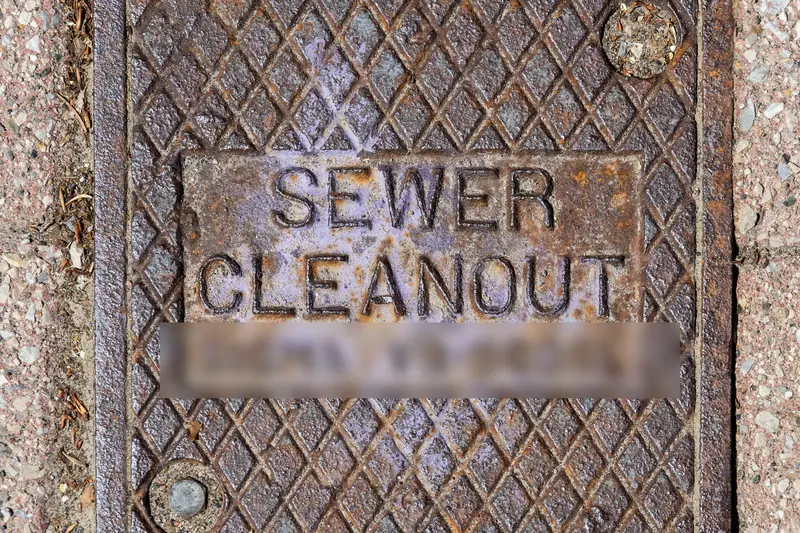
No. A cleanout, like the one in Figure 20.2, is a capped opening into the drain line. Livermore describes it as a direct access point that plumbing professionals use to reach clogs and backups in a lateral.1 It looks like an easy thing to open. On a backed-up line, the pipe behind that cap may be holding a column of sewage from every fixture above it. Opening a cleanout on a backed-up line can release sewage under pressure, all over you and whatever is near.
Leave the cap on and leave it to the drain professional, who will come equipped for that. Find out where your cleanouts are and tell the plumber, because that alone can save time. A house may have one indoors, on a stack or basement wall, or one outdoors near the foundation, and some have none at all.
A cracked or missing cap on a line that is not backed up is a different matter, because it lets drain air into the house, as Chapter 19 explains. A plumber can replace it at the same visit. The fittings are ordinary. Cleanout plugs and fittings are listed at PlumbingSupplyAndMore's cleanouts section (PlumbingSupplyAndMore has the same owners as this book), one place to look and nothing more.
20.5 What does the plumber do?
A drain professional usually starts by running a powered cable through a cleanout, and most blockages come out that way. If the same line keeps backing up, the next step is a camera. Minneapolis notes that a private company can televise a lateral to find the problem, and that the city does not determine the cause of a blockage in a private lateral.3
Roots, a collapsed section or a pipe that has lost its slope cannot be solved with a cable. Those lead to digging or lining, which is licensed work and usually needs a permit. Livermore, for one, requires a plumbing permit for lateral repairs and an additional encroachment permit if the work disturbs city streets or sidewalks.1 Your town will have its own rules, which Chapter 38 shows how to look up. Do not dig or cut this pipe yourself.
A backup feels urgent, and that is when bad decisions get made. The FTC lists pressure tactics, cash-only demands and door-to-door offers as warning signs, and suggests several written bids describing the work, materials, price and completion date.4 Clearing a blockage tonight may be worth paying for tonight. Replacing a whole lateral can wait for a second opinion, and for Chapter 39.
Cleanup is a separate job. If sewage has wet carpet, drywall or insulation, EPA says to call in a professional with experience in buildings damaged by contaminated water.5 Check your insurance, too, since coverage for backups varies.
Where the line falls
- Yours to do
- Stopping water use; keeping people clear of sewage; learning who owns your lateral and whose number to call; knowing where your cleanouts are
- For a licensed pro
- Opening a cleanout on a backed-up line; power rodding and camera inspection; any digging, cutting, lining or replacing of a sewer lateral; cleanup after a sewage backup
Notes
- City of Livermore, "Sewer Laterals - Information for Property Owners." livermoreca.gov ↩
- U.S. EPA, "Resolving Septic System Malfunctions." epa.gov ↩
- City of Minneapolis, "Home Sewer Maintenance: Common Questions." www2.minneapolismn.gov ↩
- U.S. Federal Trade Commission, "How to Avoid a Home Improvement Scam." consumer.ftc.gov ↩
- U.S. EPA, "A Brief Guide to Mold, Moisture and Your Home." epa.gov ↩