Chapter Thirty-Eight
Remodels and Permits
Part Eight: Old Pipes, New Work
By the editors of this book. Sources checked November 2, 2026.
Bathroom remodel plumbing usually comes down to one question first: does your town want a permit for this work, and who pulls it? Ask before the first wall opens, because the answer changes the schedule, the price and who can do the job. There is no national rule. The same job can need a permit in one town and not in the next.
38.1 When is a permit needed?
We can only give you examples, and two will show how much they differ. Do not read either as your own rule.
| Place | Permit needed for | Not needed for |
|---|---|---|
| Portland, Oregon | Repairing, replacing or moving any plumbing pipes; installing or replacing fixtures such as toilets, sinks, showers, tubs or dishwashers | Fixing or maintaining existing fixtures or parts; items that do not use water, such as a toilet seat |
| Santa Cruz County, California | Plumbing, gas or drainage piping, fixtures, or water heating or treatment equipment installed, altered, repaired or replaced, unless exempted | Stopping leaks in drain, soil, waste or vent pipe; clearing stoppages; repairing leaks without replacing or rearranging anything |
That comes from each place's own permit pages.1 2 Santa Cruz County also says outright that replacing a water heater takes a plumbing permit.2 Notice that in Portland, replacing a toilet is on the permit list. That sits awkwardly beside Chapter 2, where we called a fixture swap fair work for a homeowner. Both are true. Being able to do a job and being allowed to skip the paperwork are two separate matters.
Call your own building department, or look at its website, and describe the job in plain words. Say what you are moving. It costs a few minutes, and it is the only answer that counts.
38.2 May you do the work yourself?
Sometimes. Portland says homeowners can do their own plumbing work, provided they are the owner of record and not an LLC.1 Other places may say otherwise, so ask. Gas piping, water heater venting and gas connections, service lines and sewer laterals belong to licensed people regardless of what else your town allows, as this book has said throughout.
The FTC warns you to be careful if a contractor asks you to get the required building permits yourself.3 Ask why. A contractor who wants that to be you may be handing you a responsibility that should stay with the person doing the work.
38.3 What happens while the wall is open?
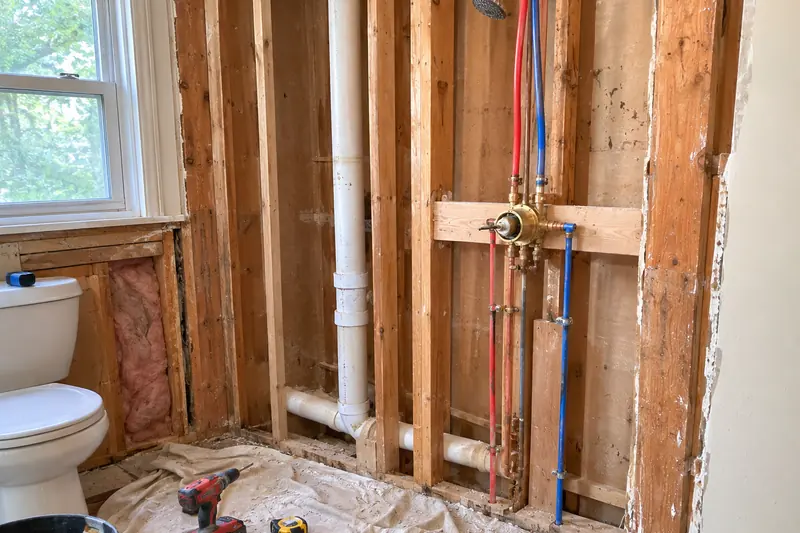
Figure 38.1 shows the stage that matters most. New supply and drain lines are in, nothing is covered, and everything can be seen. Portland's page says to call for an inspection before covering any piping with floor, wall or ceiling, and not to cover work until it is approved.1 It also requires a final inspection to close the permit.1 Other towns use their own steps, but the principle is common: an inspector can check only what can be seen.
38.4 What should you settle before the wall opens?
Much of what a remodel costs is decided at this stage, so make decisions early.
- Decide what stays where it is, since moving a toilet or a shower means moving a drain.
- Ask how a moved drain will get its fall and its vent, using Chapter 4 and Chapter 5 as your background.
- Choose the shower valve now, because it sits in the wall, as Chapter 10 explains.
- Ask for a shutoff at each fixture, and a way to reach any valve in a wall.
- Ask what the old pipes are, using Chapter 37, and whether any of them should go while the wall is open.
- Ask whether the plan needs a permit, who pulls it, and when inspections fall.
Fixtures are worth choosing with water use in mind. The federal standard for toilets is 1.6 gpf and WaterSense models use 1.28 gpf or less.4 Showerheads have a 2.5 gpm standard, with WaterSense at no more than 2.0 gpm.5 Bathroom faucets have a 2.2 gpm standard, with WaterSense at a maximum of 1.5 gpm.6
38.5 What changes in an older house?
Two things need thinking about before anyone starts cutting. First, paint. EPA's renovation rule applies to paid work that disturbs painted surfaces in homes built before 1978, and it generally requires certified firms. It does not generally apply to owners working on their own homes, unless they rent out all or part of the home, but EPA still recommends hiring a lead-safe certified contractor.7 Ask any contractor who will be opening painted walls.
Second, old pipe. Do not cut, sand or scrape pipe you have not identified. If the house may have lead pipe or old solder, raise it first, following Chapter 33. A remodel is also a sensible time to ask your utility about the service line, though that line itself stays with the utility or a licensed plumber.
38.6 Who should run the job?
Whoever does it, one person should be plainly in charge of the plumbing, the permit and the inspections, and the contract should say who. Chapter 39 sets out what that contract should contain. To see how one firm describes this sort of work, read Central Plumbing's plumbing services page (Central Plumbing has the same owners as this book). It is a plumbing company in Bucks and Montgomery County, Pennsylvania, so it is of direct use only to readers there. Elsewhere, treat it as an example of what to look for in a local firm's description of its work.
Where the line falls
- Yours to do
- Calling the building department; deciding the layout; choosing fixtures and valves; photographing open walls; swapping fixtures where your town allows it; keeping permit papers
- For a licensed pro
- Moved drains and vents; new supply runs in walls where your town wants a licensed person; any gas or water heater venting work; service line and lateral work; lead-safe paint work on older homes
Notes
- City of Portland, Oregon, "Residential Plumbing Permits." portland.gov ↩
- County of Santa Cruz, "When is a Plumbing Permit Required?" cdi.santacruzcountyca.gov ↩
- Federal Trade Commission, "How To Avoid a Home Improvement Scam." consumer.ftc.gov ↩
- U.S. EPA WaterSense, "Residential Toilets." epa.gov ↩
- U.S. EPA WaterSense, "Showerheads." epa.gov ↩
- U.S. EPA WaterSense, "Bathroom Faucets." epa.gov ↩
- U.S. EPA, "Lead Renovation, Repair and Painting Program." epa.gov ↩