Chapter Two
What You May Do Yourself
By the editors of this book. Sources checked November 2, 2026.
You can do your own plumbing for much of the ordinary work inside a house, such as fixture swaps, traps and clearing drains, but gas piping, venting, service lines and sewer laterals belong to licensed trades. The rest depends on your town. This chapter draws that line once, plainly, and the rest of the book holds to it.
2.1 What is the line, in plain words?
Work on the parts you can see, reach and shut off with a valve is generally yours. A faucet, a toilet's insides, a trap, an aerator, a showerhead: if you get one wrong, you close a stop, you mop up, and you try again.
Work is someone else's when a mistake could hurt people or stay hidden for years. Gas can kill a household. A badly vented water heater can do the same, slowly and without a smell. A service line or sewer lateral means digging, other people's property and often the utility's rules. Those are not matters of skill alone, and this book will not walk you through them.
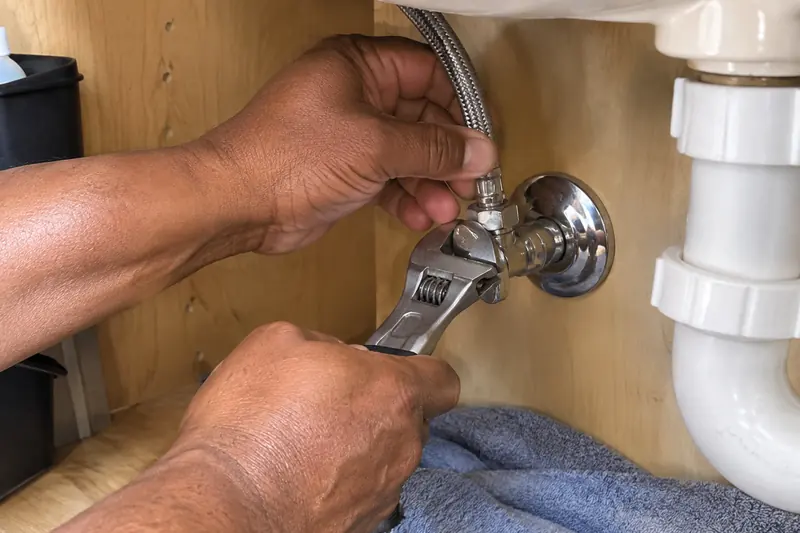
The picture in Figure 2.1 is about what we have in mind. You should be able to stop the water with your own hand before you loosen anything. If you cannot, because no valve exists or the valve will not close, the job has just changed. Chapter 6 shows where those valves are.
2.2 Common jobs, sorted
Here is the book's view of who does what. It is a general guide and not a statement of law anywhere.
| Job | Homeowner | Licensed |
|---|---|---|
| Clean or replace an aerator | Yes | |
| Replace a showerhead | Yes | |
| Replace a faucet cartridge or the whole faucet | Yes | |
| Change a flapper or fill valve | Yes | |
| Replace a toilet and wax ring | Yes | |
| Take off, clean or replace a sink trap | Yes | |
| Clear a drain with a plunger or hand snake | Yes | |
| Close your own shutoffs | Yes | |
| Replace washer hoses | Yes | |
| Replace a stop under a sink | Often, if it is a compression fitting | If soldered or stuck |
| Replace a shower valve inside the wall | Yes | |
| Replace a water heater, on either fuel | Yes | |
| New supply or drain lines in walls | Yes, usually with a permit | |
| Add, move or alter a vent | Yes | |
| Install a pressure regulator | Yes | |
| Any gas piping or gas connection | Yes | |
| Water heater venting | Yes | |
| Service line from the street | Yes, or the utility | |
| Sewer lateral | Yes, or the city |
Read "Yes" in the homeowner column as "reasonable for a careful person." It does not mean every town agrees, and it does not mean you are obliged to try. Hiring out a job you could do is a respectable decision, and Chapter 39 covers how to do it well.
2.3 Do you need a permit for your own house?
Rules vary by town, and sometimes by county or state. Many jurisdictions let owners do some work on their own house with a permit, while others limit what an unlicensed person may touch, even at home. This book does not list those rules, because they change and any list would mislead someone.
Ask your local building department before you start anything beyond a like-for-like fixture swap. Tell them the job, the address and that you own and live in the house. Ask whether a permit is needed, whether an owner may pull one, and which inspections follow. It is a short conversation, and it may save you from tearing out finished work. Chapter 38 goes further for larger projects.
2.4 What stays licensed, and why?
Four kinds of work stay on the licensed side of the line in every chapter of this book.
Gas comes first: piping and connections, including those on water heaters, dryers and ranges. If you ever smell gas, leave the building at once. Touch no light switches and make no calls from inside; call 911 and the gas utility from outside, well away from the smell, and stay out until you are told it is safe.2
Venting is second, meaning both the flue on a fuel-burning water heater and the drain vents through your roof. The first carries combustion gases out of the house, and the second protects every trap you own. Chapter 5 explains what the drain vents do, so you can recognize trouble even though you will not rebuild them.
Service lines are third. That means the pipe that brings water from the street, along with any street-side valve or curb stop. You use the valve at the house. The utility or a licensed plumber handles the rest.
Sewer laterals are fourth. That is the pipe from your house to the public sewer. Ownership varies more than people expect: Livermore, California, holds the owner responsible as far as the point of connection and tells owners to call the city first, and other cities draw the line elsewhere.3 Ask your own city before anyone digs. Chapter 20 has more.
2.5 How do you know when to stop?
Some signs tell you a job has outgrown you, however it looked at the start.
| What you find | What to do |
|---|---|
| A valve will not close fully and you cannot stop the water | Stop and call a plumber |
| A fitting will not move under moderate force and the pipe behind it starts to twist | Stop before something breaks |
| Old pipe you cannot identify, or pipe that may contain lead | Do not cut, sand or scrape it; read Chapter 33 |
| Water on the floor near outlets, a panel or appliances | Stay out of it; use a breaker only from a dry spot, otherwise call the utility or fire department from outside |
| A job you cannot put back together the same day | Leave it for someone who can |
Stopping halfway is not a failure. A plumber who arrives to find one honest, well-described problem will have an easier time than one who finds three attempts stacked on top of it. Tell them what you did.
2.6 If you have a problem right now
You may have opened the book here because something is leaking. Go to Jump In by Problem, which sends you straight to the right chapter, and come back to this one later. If water is running where it should not be, close the main shutoff first and read second, if you can reach it without walking through water near electricity.
Where the line falls
- Yours to do
- Aerators, showerheads, faucets and cartridges; flappers, fill valves and toilets; sink traps; washer hoses; plungers and hand snakes; asking your building department what an owner may do
- For a licensed pro
- Gas piping and gas connections; water heater venting; drain vents; service lines and curb stops; sewer laterals; in-wall work and anything your town permits only to a license holder
Notes
- Federal Trade Commission, "How To Avoid a Home Improvement Scam." consumer.ftc.gov ↩
- Washington Utilities and Transportation Commission, "Pipeline Emergencies." utc.wa.gov ↩
- City of Livermore, California, "Sewer Laterals." livermoreca.gov ↩