Chapter Three
How Water Reaches the Tap
By the editors of this book. Sources checked November 2, 2026.
Water gets to your house through a large main under the street, a smaller service line to your property, a meter, and then a main shutoff where it enters the building. From there it branches to every fixture. Knowing the order tells you who is responsible for each stretch and which valve stops what. Wells differ at the start, and we will come to them.
3.1 What happens before water reaches your property?
A public water system treats the water and keeps it under pressure in a network of mains. Each year, community water systems send customers a Consumer Confidence Report by July 1, which says what is in the water and where it comes from.1 It is the one document that describes this part of the trip, and Chapter 32 explains how to read it.
A smaller pipe, the service line, taps the main and runs to your house. Somewhere along it there is usually a valve near the property line, often called a curb stop. It belongs to the utility or to a licensed plumber working with them. Leave it alone even when you have a burst pipe, and use the valve at the house.
Who owns which length of service line varies from one utility to the next, so ask yours. You should also know what it is made of. Where lead service lines are present, EPA says they are usually the biggest source of lead in the home's water, and they are more likely in older cities and in homes built before 1986.2 3 Chapter 33 says what to do about that. Beyond the gentle check in Chapter 33, do not dig, cut or scrape to find out.
3.2 Where is the water meter?
In warmer places the meter usually sits outside in a covered box near the street, like the one in Figure 3.1. In cold places it is often inside, in a basement or utility room, where it will not freeze. If you have no meter, the utility may bill a flat rate, or you may be on a well.
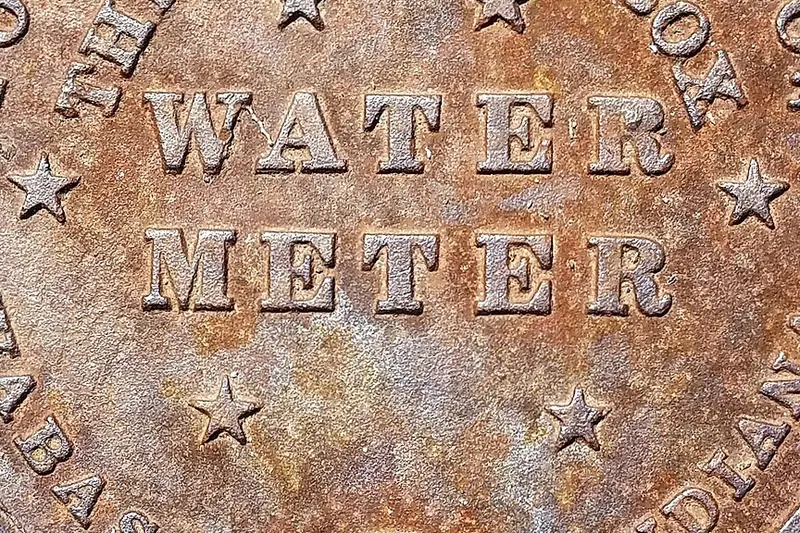
You can read the meter even if you may not adjust anything near it. Lift the lid gently, since things live in those boxes, and look at the dial. Any valve you see in there is not for you.
The dial has a practical use. EPA's check for a hidden leak is to read the meter, use no water for two hours, and read it again. If the number has moved, water is leaving somewhere.4 Chapter 28 takes it from there.
3.3 What is on your side of the meter?
Past the meter you usually come to the parts below, in about this order, though not every house has all of them.
| Part | What it does |
|---|---|
| Main shutoff | Stops water to the whole house; sometimes where the pipe comes through the wall, sometimes in a garage or closet |
| Pressure regulator | A bell-shaped valve in homes where street pressure runs high; one California utility calls it the customer's to install and maintain, on the customer's side of the meter5 |
| Softener or whole-house filter | Treats the water from here on, if you have one; see Chapter 35 |
| Hose faucets | Often tapped off before any softener, since a lawn does not need softened water |
Chapter 7 covers the regulator and how to tell whether you have one.
From there the cold line runs through the house, and one branch feeds the water heater. Hot water rises out of the top of the heater and follows its own route to the fixtures. Chapter 22 explains what happens inside. A long way from the heater, you wait longer for hot water, because all the cooled water in the pipe has to come out first.
3.4 How does water get upstairs?
Pressure carries it up. Each foot of height costs a little under half a psi, so a second-floor shower 20 feet above the meter loses about 9 psi to height alone. That is why upstairs fixtures can feel weaker than downstairs ones even with everything in good order.
Municipal systems often get their pressure from height too. A water tower, or a tank on a hill, is simply water stored above the houses it serves. Pumps also play a part, and your utility can tell you which arrangement yours uses and what pressure to expect at your address.
3.5 What if you are on a well?
Everything upstream of the house is then yours. A pump lifts water from the ground into a pressure tank, and a pressure switch turns the pump on and off, so the supply side inside the house looks about the same as anybody else's.
The difference is responsibility. EPA says private well owners are responsible for the safety of their water, and federal law and most state laws do not regulate it.6 No Consumer Confidence Report arrives in the mail. Chapter 36 covers testing and what to look for.
3.6 Why trace the route yourself?
Walk the route once, on a calm day. Start at the meter and work inward, and mark on a sketch where the line enters, where the main shutoff is and what comes after it. Keep the sketch somewhere you will find it in a hurry. You are not repairing anything; you are making sure that the first minutes of an emergency are spent closing a valve instead of looking for one.
Where the line falls
- Yours to do
- Reading the meter; finding and using the house-side main shutoff; sketching the supply route; asking the utility about service line material and ownership
- For a licensed pro
- Curb stops and street-side valves; any digging, cutting or replacing of a service line; meter work, which is the utility's; well pumps and pressure switches, unless you are trained for that work
Notes
- U.S. EPA, "CCR Information for Consumers." epa.gov ↩
- U.S. EPA, "Protect Your Family from Sources of Lead." epa.gov ↩
- U.S. EPA, "Basic Information about Lead in Drinking Water." epa.gov ↩
- U.S. EPA WaterSense, "Fix a Leak Week." epa.gov ↩
- Rainbow Municipal Water District, "Water Pressure Regulator FAQs." rainbowmwd.ca.gov ↩
- U.S. EPA, "Private Drinking Water Wells." epa.gov ↩