Chapter Twenty-Eight
Finding a Leak
By the editors of this book. Sources checked November 2, 2026.
To find a water leak, start at the water meter, because it counts every gallon whether you can see the leak or not. Then narrow the search by closing things off one at a time. No special tools are needed for most of this, only patience and a clock. The U.S. Environmental Protection Agency says the average household's leaks can waste more than 9,300 gallons a year.1
That is not a rare problem. The EPA says 9 percent of homes have leaks wasting 50 gallons or more a day,1 and an average family uses more than 300 gallons a day at home.2 A leak of that size is a sixth of your water use, spent on nothing.
28.1 How do you test the meter for a leak?
This is the test to do first. The EPA's version is about as simple as a home test gets: check the meter before and after a two-hour period when no water is being used.1 If the reading changes at all, you probably have a leak.1
- Find your meter. Chapter 3 describes where it usually lives. If it sits in a box in the ground, lift the lid with care and look out for insects. Leave any valve in there alone. Your utility can help if the lid is locked or you cannot find it.
- Choose two hours when nobody needs water. Turn off anything that uses it on its own, such as a washer, dishwasher, icemaker or irrigation timer.
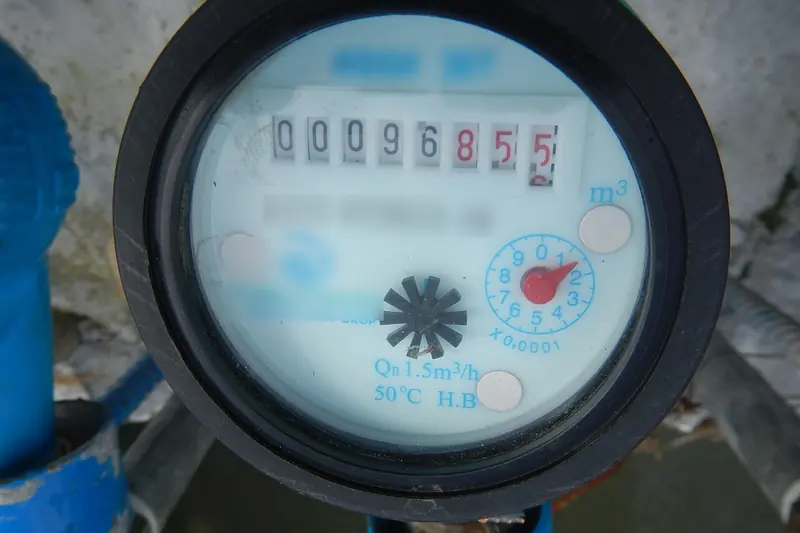
- Write down the reading, or take a photo of the dial.
- Come back after two hours and read it again, without using any water in between.
Many meters also have a small triangle or wheel, as in Figure 28.1, that turns with even a tiny flow. If it creeps with everything off, you do not need the full two hours to know something is running.
28.2 Is the leak inside the house or outside?
The next test splits the problem in two. Close the main shutoff at the house, the valve we found in Chapter 6, then go and look at the meter again.
If the meter stops, the leak is on the house side of that valve: a fixture, a pipe, the heater, something you can go on looking for. If the meter keeps moving with the main shutoff closed, the leak is between the meter and the house. That is the service line. Service lines belong to the utility or a licensed plumber, depending on where you live. Do not dig for it. Do not touch the curb stop or any street-side valve. Call your water utility first and ask what they will check.
28.3 Where do leaks usually hide?
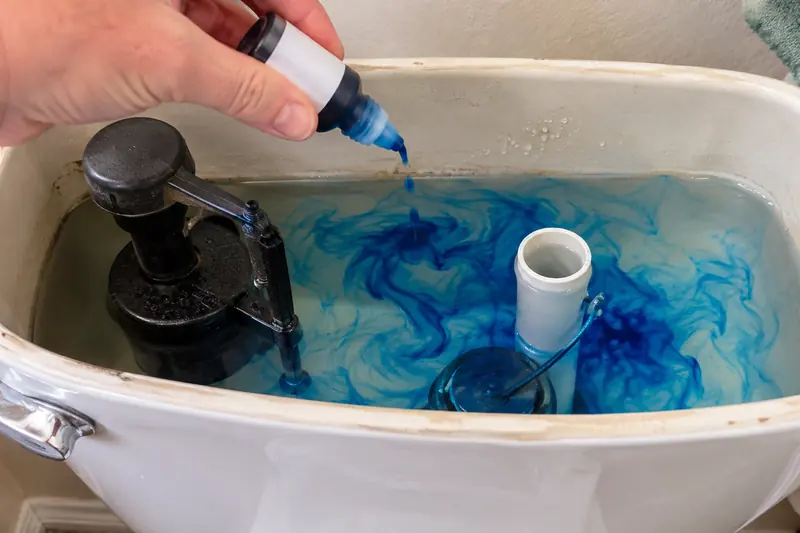
Go through the house in order, starting with the likeliest places. Toilets come first, because they leak silently. The EPA's test is a few drops of food coloring in the tank, shown in Figure 28.2. If any color shows up in the bowl within 10 minutes without flushing, you have a leak.1 Chapter 13 covers the fix. Flush when the test is done so that the coloring does not stain. The drip figures and the irrigation advice in the table come from the same EPA page.1
| Place | What to look for | The EPA's number |
|---|---|---|
| Toilet | Color in the bowl, or a faint hiss | No single figure |
| Faucet | A drip at the spout or around the handle | One drip per second is more than 3,000 gal/yr |
| Showerhead | A drip after the water is off | 10 drips per minute is more than 500 gal/yr |
| Under sinks | Damp cabinet floor, wet fittings, swollen shelf | No single figure |
| Hose faucets and irrigation | Wet soil, a green patch in a dry spell | Check irrigation each spring |
The EPA also tells you to look for water on the outside of pipes and fittings.1 Dry each joint with a paper towel and come back later. A wet towel tells you what your eyes may not. Faucet repairs are in Chapter 8, and Chapter 11 covers the hoses behind washers and refrigerators.
Water near the heater needs a closer look. Water from the discharge pipe is a relief valve issue, and that is in Chapter 24. A leak from the tank itself cannot be repaired. Keep your hands off anything that may be hot.
28.4 What about leaks you cannot see?
A hidden leak leaves signs: a stain that grows, paint that blisters, a floor that lifts or a musty corner, or the sound of water with every tap closed. Mark the edge of a stain in pencil and check it the next day. Growth says the leak is active. A stain that does not change may be an old one.
Leave the digging to a plumber. Opening walls blind is expensive and rarely finds the source first time, and plumbers have listening and imaging tools that do it with fewer holes. Before they come, run the meter test and write the result down. That saves time on the visit.
If a ceiling is sagging or dripping, do not stand beneath it, and keep clear of light fixtures. If water is reaching outlets or a panel, the rules in Chapter 29 apply: do not walk through it.
28.5 Why not wait?
Water bills are the small part of it. Texas's insurance regulator says most home policies cover sudden and accidental water damage but usually will not cover damage from gradual leaks, and that water damage hidden from view must usually be reported within days after you first see it.4 Your own policy and state may differ. Read yours. Either way, a leak you have noticed is a good one to deal with this week.
Where the line falls
- Yours to do
- Reading the meter; the two-hour test; the dye test in each toilet; closing the main shutoff to split the search; checking joints with a paper towel; fixing the fixtures this book covers
- For a licensed pro
- Locating leaks in walls, slabs or ceilings; anything on the service line, which goes to the utility or a licensed plumber; repairing soldered or buried pipe
Notes
- U.S. Environmental Protection Agency, WaterSense, "Fix a Leak Week." epa.gov ↩
- U.S. Environmental Protection Agency, WaterSense, "How We Use Water." epa.gov ↩
- Rainbow Municipal Water District, "Water Pressure Regulator FAQs." rainbowmwd.ca.gov ↩
- Texas Department of Insurance, "When are water damage and mold covered by insurance?" tdi.texas.gov ↩