Chapter Twenty-Four
The Relief Valve
By the editors of this book. Sources checked November 2, 2026.
A temperature and pressure relief valve is the safety device that opens and lets water out of a water heater if the heat or pressure inside climbs too far. Without it, a tank that overheats has no way to let go. A. O. Smith's manual puts the stakes plainly: an explosion could occur if the valve or its discharge pipe is blocked.1 Everything else in this chapter follows from that sentence.
Never cap, plug or remove the valve or its discharge pipe. Do not do it to stop a drip, to tidy a basement, or for a week until the plumber can come. The manual also warns against running a heater without a working valve.1
24.1 What does the relief valve do?
It watches two things at once. Water that gets too hot is one danger. Water under too much pressure is the other, and heating raises pressure on its own, because water expands and in many homes has no path back to the street.1
When either limit is passed, the valve opens and sends water down the discharge pipe. That is the valve doing its job. Figure 24.1 shows where to look: near the top of the tank, with a small lever and a pipe leading down.
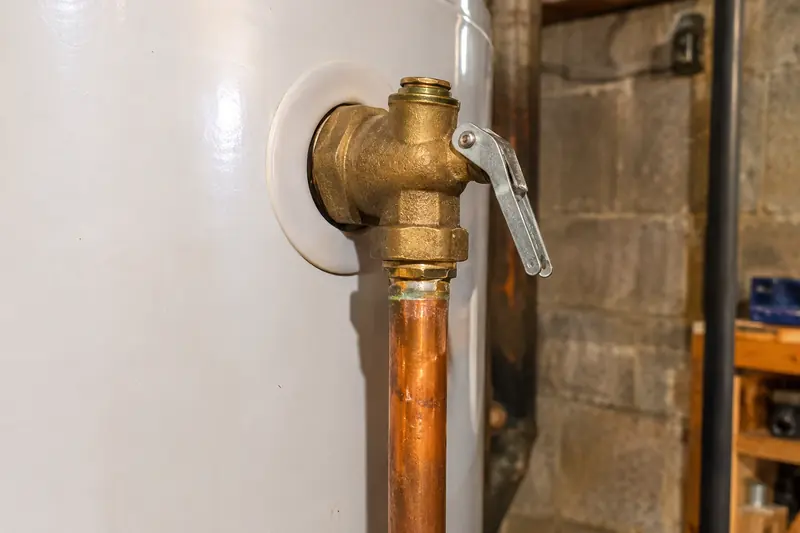
24.2 Why does the discharge pipe matter?
A valve can only protect the tank if its water can get out, and that water can be hot enough to burn badly.1 So the pipe exists to take it somewhere that will not hurt anyone. The A. O. Smith manual, for its own heaters, says the pipe must not be smaller than the valve's outlet, must be copper or CPVC and not a hose, and must end no more than six inches above a floor drain, or else outside the building.1 Your manual and your town may differ in the details.
Look at yours. If it is missing, has been cut short, has been reduced to a smaller size, runs into a hose, or has been fitted with a cap, call a plumber and say so. Do not fix it by improvising. Keep boxes and stored things away from the end of it, and teach everyone in the house never to put a hand there.
24.3 Why is my relief valve dripping?
A valve that drips, or a discharge pipe that runs, is a plumber call. It is not something to plug. A bucket under a slow drip is fine while you wait, as long as nothing touches the end of the pipe.
The plumber will look at a short list. A. O. Smith's manual gives these causes for a small drip: house water pressure that is too high, a missing or failed thermal expansion tank, and, rarely, debris holding the valve off its seat.1 If all of those are ruled out, the valve itself may be broken and should be replaced by a qualified person.1
You can help before the visit. Measure your house pressure at a hose faucet as described in Chapter 7, where we give the usual range of 30 to 80 psi from one California utility.2 Knowing the number shortens the conversation. Note when the drip happens too. A drip that shows up after a long shower, as the tank reheats, points toward expansion.
24.4 What if it pours very hot water?
A large flow of very hot water may mean the tank is overheating.1 Treat it as urgent and stay clear of the pipe.
- If you hear loud noises, see steam, or if water is near outlets or the electrical panel, leave the building and call 911 from outside. If you smell gas, leave first, touching no switches and using no phone inside; call 911 and the gas utility from outside and well away, and stay out until they clear it.
- Otherwise, keep everyone away from the discharge pipe and the water coming from it.
- On an electric heater, switch off the water heater breaker if you can reach it from a dry spot. If you cannot, skip this step.
- On a gas heater, do nothing at the control. Call the gas utility or a licensed plumber now and tell them what you are seeing.
Do not try to stop the water. It is leaving for a reason. An electric heater's breaker then stays off until a plumber has found the cause.
24.5 Should you test the valve?
Makers say yes, and they also warn you about it. A. O. Smith's maintenance page tells owners to lift the lever a few times once a year to see that water discharges. It says a professional should check the valve every five years.3 One of its manuals says every two to four years and sends you to the label on the valve for the schedule.1 The label on your own valve is the one to follow.
There is a reason some owners leave this for the plumber. A valve that has sat still for years may not seat again, and then you have a drip to deal with. Choose a day when you could get a plumber if needed, and never do it if the discharge pipe is missing or ends where water could hit someone.
- Read the label on the valve and follow it where it differs from these steps.
- Check that the pipe is whole and that nobody and nothing is near where it ends. The water may be extremely hot.1
- Lift the lever gently and let it back down, a few times, keeping your hands and face away from the pipe.
- Listen for water going down the pipe, then for it to stop. If it keeps running or starts to drip, call a plumber. Do not plug it.
If lifting the lever produces no water at all, the valve may be stuck. That is also a plumber call, and a prompt one, because a stuck valve is no protection.
24.6 Who replaces a relief valve?
In this book, a licensed plumber does. The job means draining down the tank and leaving behind a valve of the right rating, and the valve is the last line of defense for an appliance holding many gallons of pressurized hot water. Chapter 39 covers how to hire someone. Fixes for high pressure, such as a pressure regulator or an expansion tank, are plumber work too, and Chapter 22 explains why they matter.
If you want to read what the different valves are rated for before that call, PlumbingSupplyAndMore's relief valves section (PlumbingSupplyAndMore has the same owners as this book) is one place to look. It is useful for vocabulary and is not a reason to fit one yourself.
Where the line falls
- Yours to do
- Finding the valve and following its pipe to the end; keeping that end clear; a lever test by the label if you accept the risk of a drip; measuring house pressure; a bucket under a drip
- For a licensed pro
- Replacing the valve or its pipe; expansion tanks and pressure regulators; any valve that drips, runs or will not discharge; an overheating tank
Notes
- A. O. Smith, "Installation Instructions and Use & Care Guide, Residential Gas Water Heater." assets.hotwater.com ↩
- Rainbow Municipal Water District, "Water Pressure Regulator FAQs." rainbowmwd.ca.gov ↩
- A. O. Smith, "Water Heater Maintenance Guide." hotwater.com ↩