Chapter Thirty-Six
If You Have a Well
Part Seven: What Is in the Water
By the editors of this book. Sources checked November 2, 2026.
Well water testing is your job, because a private well has nobody else checking it: EPA says owners are responsible for delivering safe drinking water to their households. There is no supplier, no yearly report, and no utility to ring when the water tastes odd. Federal law does not regulate private well water, and most state laws do not either.1 That is the freedom of a well, and also its cost.
36.1 How much does it matter?
EPA cites a U.S. Geological Survey study of 2,100 private wells that found about one in five had a contaminant above a human-health benchmark.1 That means most wells in the study came up clean, and that a fair number did not. A well that has tasted fine for years tells you only that it has tasted fine. Many of the things worth testing for have no taste at all.
36.2 What should you test for, and when?
EPA's basic advice is to test once a year for total coliform bacteria, nitrates, total dissolved solids and pH.2 Test sooner if something changes, such as a flood, construction nearby, or a shift in the taste, smell or color of the water.2
Beyond the basic four, what you test for depends on what is around you. If you suspect something else is present, EPA says to test for that too.2
| What is nearby | What to ask the lab about |
|---|---|
| Farmland | Nitrates and pesticides |
| A gas station | Volatile organic compounds |
| Anything you have reason to suspect | That specific contaminant |
Lead belongs on the list if your house or your well's fittings are old enough to raise the question in Chapter 33. Hardness is worth a test too, for the reasons in Chapter 34.
36.3 Where does the sample go?
Only to a laboratory certified to do drinking water testing, EPA says. Your local health department may offer free testing for private wells, so ask there first.2 EPA also keeps a directory of state programs for private well owners, though many states set few or no rules.3
- Call your county or local health department and ask about testing and certified labs.
- Get the sample bottles and the lab's written directions.
- Collect the sample exactly as the lab says, from the tap the lab names.
- Read the results against the benchmarks on the lab report, and ask the lab about anything you do not follow.
- Keep every year's results together, so that you can see a change.
- If something comes back high, ask the health department what to do before you buy anything.
36.4 What should you look at around the well?
Look at the top of it now and then. Figure 36.1 shows the part you can see. EPA says to install a well cap or sanitary seal to keep out both people and contaminants, and to inspect regularly for cracked or damaged casing, a broken cap, or cracked surface seals.2
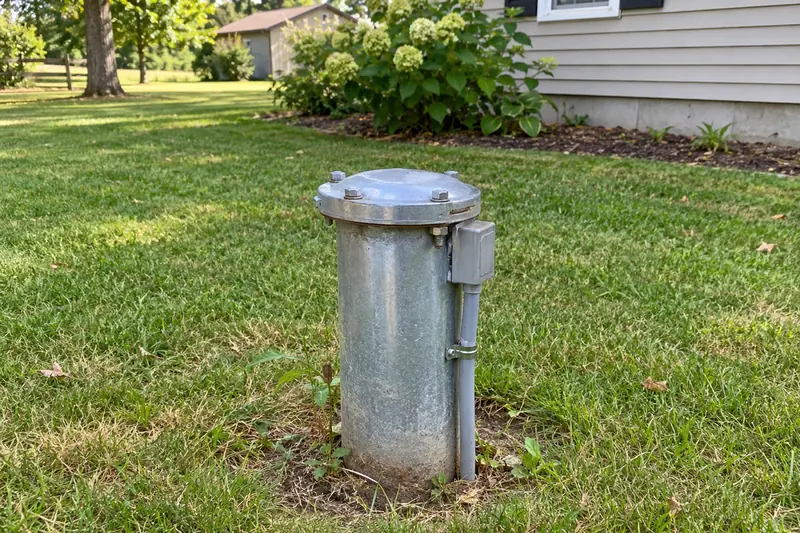
What goes on the ground nearby matters as well. EPA says never to dispose of harsh chemicals, solvents, petroleum products or pesticides in a septic system or dry well. It also says to have a septic system pumped and inspected as often as your local health department recommends.2 Chapter 21 covers that system, which on many well properties is the other half of the same story.
36.5 What do you do after a flood?
Treat the water as unsafe. EPA is direct: do not drink or wash from a flooded well, and stay away from the well pump while it is flooded, to avoid electric shock.2 Use bottled or otherwise safe water until the well has been cleaned and tested. If possible, use a contractor with experience in servicing drinking water wells to inspect and test it.2 Do not open up a flooded well yourself.
If water is standing near your panel or appliances, the warning in Chapter 29 applies as well: do not walk through it.
36.6 When is treatment the answer?
After a test, and only after. The Minnesota Department of Health advises trying to remove the source of contamination, or switching to a safer supply, before relying on home treatment, and it says no single unit removes all contaminants.4 Bacteria, nitrates and hardness call for different equipment, and Chapter 35 sets out what certification to look for. Once anything is installed, test the treated water to see that it works.4
A softener handles hardness, nothing else on the list above. It is not a treatment for contamination, and well owners should settle the safety questions first. If hardness is the one remaining problem, one place to look is SoftPro's well water softener page (SoftPro Water Systems has the same owners as this book). It is not the only option, and your own test results should decide whether it is any use to you. On septic, remember the extra load a softener can put on the drainfield.5
36.7 Who works on the well itself?
For any new well construction, modification, abandonment or closure, EPA says to hire a certified well driller.2 That includes a well you no longer use, which has to be closed properly rather than simply forgotten. Well pumps are electrical as well as plumbing. Your state's rules on who may do what vary, so ask your state or county.
Where the line falls
- Yours to do
- Yearly testing through a certified lab; keeping results; looking over the cap and casing; keeping chemicals away; asking the health department what a result means
- For a licensed pro
- New wells, modifications and closures, to a certified well driller; pump and electrical work; inspection and cleaning after a flood; cutting treatment equipment into the line
Notes
- U.S. EPA, "Private Drinking Water Wells." epa.gov ↩
- U.S. EPA, "Protect Your Home's Water." epa.gov ↩
- U.S. EPA, "Private Drinking Water Well Programs in Your State." epa.gov ↩
- Minnesota Department of Health, "Home Water Treatment" (PDF). health.state.mn.us ↩
- Penn State Extension, "Water Softening." extension.psu.edu ↩