Chapter Thirty-Four
Hard Water
Part Seven: What Is in the Water
By the editors of this book. Sources checked November 2, 2026.
Hard water is water carrying a lot of dissolved calcium and magnesium. USGS calls it a nuisance rather than a health concern.1 It leaves a crust on the faucet, a film on the shower door and spots on the glasses. Nothing here is an emergency, and that should set the pace of any buying decision. Get the number first.
34.1 What makes water hard?
Water picks up minerals on its way through rock and soil. Hardness is the measure of the calcium and magnesium it is still carrying when it reaches you.1 Those minerals do two things in a house. They react with soap and leave a residue, so you need more soap to get the same work done.1 And when the water is heated, they come out as solid calcium carbonate.1
That second one is the expensive one. USGS says scale can shorten the life of equipment and raise the cost of heating water, and that long use of hard water through a pipe can build up scale inside it.1 The sediment in the bottom of a tank, which Chapter 25 deals with, is often the same material.
34.2 How hard is hard?
Figure 34.1 gives the USGS scale. It runs from 0 to 60 mg/L as calcium carbonate for soft water up to over 180 for very hard.1
Test kits and softener makers often use a different unit, grains per gallon, or gpg. One gpg is about 17 mg/L, so divide a mg/L figure by 17 to convert it.2 A report of 170 mg/L is about 10 gpg, which sits in the Hard band. Penn State's extension service says levels below 7 gpg will probably not cause major scaling and soap film.2
34.3 How do you find your number?
There are a few easy ways to do it, and none of them needs a visit from anyone.
- Look in your yearly water report, described in Chapter 32, or ask your supplier for the hardness figure.
- On a well, or if the supplier cannot say, use a test kit or send a sample to a lab.
- Write the number down with the unit, and read it against the scale above.
- Check the softer signs: crust on faucets, spots on glassware, and film on tubs.
The Minnesota Department of Health names a test kit or a laboratory as the two ways to measure hardness.3 One place to look for a kit is Quality Water Treatment's hardness, iron and pH field test kit (Quality Water Treatment has the same owners as this book). It is not the only kit, and a lab result is just as good.
34.4 What do you notice around the house?
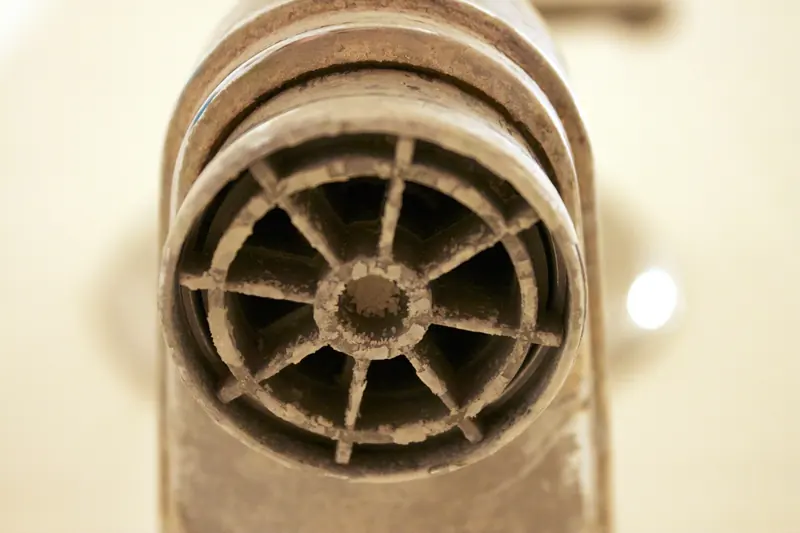
Scale like Figure 34.2 shows up first where water evaporates. It also collects in the aerator, and it can narrow the flow until the faucet seems to be failing, which is the subject of Chapter 9. In a heater it settles to the bottom of the tank. A. O. Smith says most tanks should be flushed at least once a year, and more often in hard water.4
34.5 Should you do anything about it?
There is no rule. Penn State puts it as a plain choice: accept the hardness, or treat the water to reduce the calcium and magnesium.2 The case for treating is real. The Minnesota Department of Health lists less scale on pipes, fixtures and heaters, longer life for some appliances, fewer spots on glassware and less soap film.3
The case against is real too. A softener needs salt and upkeep, and it uses water. Softening with sodium chloride adds sodium, about 7.5 milligrams per quart for each gpg removed, by Penn State's figure, which matters to anyone on a low-sodium diet.2 Minnesota's advice is to keep an unsoftened tap for cooking and drinking, and it notes that softened water can corrode pipes.3 Penn State suggests softening showers, sinks and laundry and leaving out toilets, outside spigots and basement sinks.2 Chapter 35 takes up how a softener works and what it does not do.
If you do look at softeners, read the salt, water use and installation requirements before you read anything else. One example of what is sold is SoftPro's Eco softener page (SoftPro Water Systems has the same owners as this book). It is one place to look, not the only one or necessarily the best for your water. Size any unit against your own tested number.
34.6 What does softening not do?
It does not make water safer. Hardness is not a health concern to begin with, so removing it does not fix one.1 Penn State says softeners will not necessarily remove the more serious drinking water contamination problems.2 If you are worried about what is in your water rather than what it does to your shower door, start with Chapter 33 or, on a private supply, Chapter 36.
Where the line falls
- Yours to do
- Finding your hardness number; using a test kit; soaking scale off an aerator; keeping up with the salt on a softener you own; flushing an electric tank with the breaker off, per the manual
- For a licensed pro
- Cutting a softener into the main water line; a new drain for its discharge; any permit your town asks for on treatment equipment; pipes narrowed by scale
Notes
- U.S. Geological Survey, "Hardness of Water." usgs.gov ↩
- Penn State Extension, "Water Softening." extension.psu.edu ↩
- Minnesota Department of Health, "Home Water Softening." health.state.mn.us ↩
- A. O. Smith, "Water Heater Maintenance." hotwater.com ↩