Chapter Thirty-Two
Reading Your Water Report
Part Seven: What Is in the Water
By the editors of this book. Sources checked November 2, 2026.
A consumer confidence report is the yearly account your water supplier must give you of where your water comes from and what was found in it. Most people throw it away, or never learn that it exists. It is a dull document, and worth ten minutes once a year. This chapter shows you what it says and, just as usefully, what it cannot say.
32.1 What is a consumer confidence report?
It is an annual drinking water quality report, required by EPA of community water systems. Your supplier must send it to customers each year by July 1.1 The name is awkward, and some suppliers call it a water quality report or an annual report. Those are the same document.
By EPA's account the report names the source of your water, whether a lake, a river or an aquifer. It summarizes the risk of contamination to that source. It lists the regulated contaminants found in the local water, explains the health effects of anything found in violation of an EPA standard, and says what the system is doing about it.1 It also carries a statement for vulnerable people about Cryptosporidium, and information on nitrate, arsenic or lead where those apply.1
If you draw from your own well, nobody sends you one. That job falls to you, and Chapter 36 covers it.
32.2 Where do you find yours?
Look first in the mail and on your water bill, since many suppliers now send a link rather than a booklet. If you cannot find it, EPA says to call your local water supplier or use its online search tool for reports.1 You will need the name of your water system, which is usually printed on the bill. If you rent, or the bill goes to a landlord or an association, the system's name is still what you search for.
Your state may add its own material to the report, but the federal basics must be there.1
32.3 What do the words in the table mean?
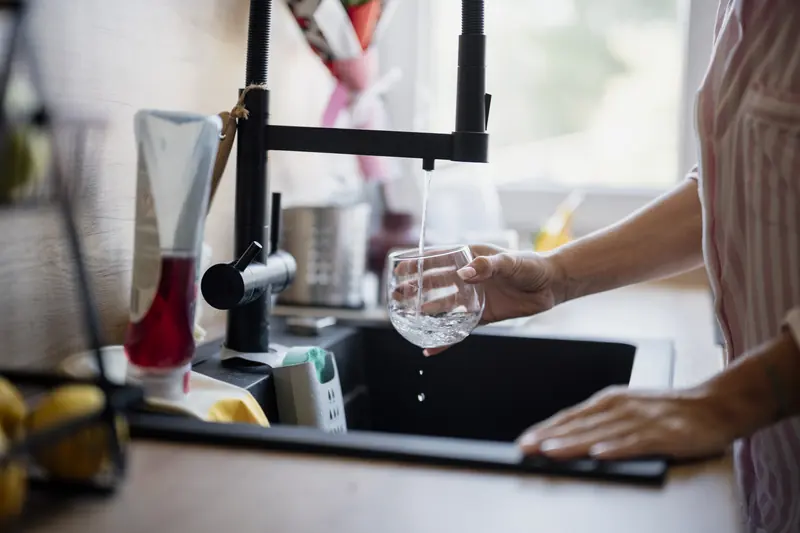
The heart of the report is a table with a row for each contaminant detected. Federal rules set out what several of its terms mean, and Figure 32.1 is what all of them come down to in the end: the water you actually drink.
| Term | What it means |
|---|---|
| MCL (maximum contaminant level) | The highest level of a contaminant allowed in drinking water |
| MCLG (maximum contaminant level goal) | The level below which there is no known or expected risk to health, with a margin of safety |
| Action level | The concentration that, if exceeded, triggers treatment or other requirements for the system |
| Treatment technique | A required process meant to reduce the level of a contaminant |
| Variance or exemption | State or EPA permission not to meet an MCL or a treatment technique under certain conditions |
These definitions come from the rule that governs the reports, so yours should use the same words.2 The difference between the first two rows matters most. An MCL is a legal limit. An MCLG is a health goal. They are not always the same number, and a result can sit between the two without being a violation.
32.4 How do you read it in ten minutes?
You do not have to read it in order. Go straight to the things that can change what you do.
- Find the source of your water on the first page or two.
- Look for the word "violation" anywhere in the report, and read that section in full.
- Find the table and read across each row: the amount found, the limit, and the goal.
- Find the row for lead and read the 90th percentile figure and the number of sites over the action level.
- Find the hardness figure if the report gives one, and write it down for Chapter 34.
- Keep the report with your other house papers, so you can compare it with next year's.
32.5 What can the report not tell you?
It cannot tell you about your own pipes. The system tests its water, and a house adds its own plumbing between the street and the glass. That is why lead is reported differently from almost everything else. For lead and copper the report gives the 90th percentile of tap samples, the number of sampling sites over the action level, and the range of results.2 In plain terms, the 90th percentile is the level that nine out of ten sampled taps were at or below. A good figure there says nothing about whether your faucet is the tenth.
The way to learn about lead at your own tap is to test it, because you cannot see, taste or smell lead in water.3 Chapter 33 covers how. Hardness is not a health concern, according to USGS, so it may or may not appear in the table at all; your supplier can tell you if it does not.4
32.6 When should you act on what it says?
Read the corrective action section if there is one, and follow what your supplier says to do. If something in the report worries you, ask the supplier first. It wrote the report, and it knows its own system and its own history.
Do not buy treatment equipment on the strength of one row in a table. A filter has to match a particular contaminant, and no single treatment unit removes everything, as Chapter 35 explains.5 A report that is entirely in order is a reason to keep your money. Health questions belong with your doctor, and this book does not try to answer them.
Where the line falls
- Yours to do
- Finding the report; reading the table and the violations section; asking the supplier what a row means; ordering a test of your own tap
- For a licensed pro
- Laboratory analysis of any sample, which goes to a certified lab; fitting whatever treatment or pipe work a real result points to
Notes
- U.S. EPA, "CCR Information for Consumers." epa.gov ↩
- Code of Federal Regulations, 40 CFR 141.153, "Content of the reports." law.cornell.edu ↩
- U.S. EPA, "Protect Your Family from Sources of Lead." epa.gov ↩
- U.S. Geological Survey, "Hardness of Water." usgs.gov ↩
- Minnesota Department of Health, "Home Water Treatment." health.state.mn.us ↩