Chapter Thirty-Seven
Telling Old Pipes Apart
Part Eight: Old Pipes, New Work
By the editors of this book. Sources checked November 2, 2026.
Types of plumbing pipes in an old house can usually be told apart with your eyes and a magnet, and you should know which ones you have before anyone quotes you a repair. Most houses hold more than one. Builders chose by what was available, what it cost and what was accepted at the time, according to HUD, so a house records its own history in its pipes.1 Bring a flashlight and do not cut anything.
37.1 What are you likely to find?
HUD lists the materials used in homes over the years as lead, galvanized steel, copper, PVC, CPVC, polybutylene and PEX.1 The drains are a separate family, and Chapter 4 takes up those. Here we keep to the water supply lines, which you can usually see at the heater, under the sinks and in the basement or crawl space.
| Pipe | How it looks | Magnet |
|---|---|---|
| Copper | Penny colored, with smooth soldered joints | Does not stick |
| Galvanized steel | Dull gray, with threaded joints and fittings | Sticks |
| Lead | Dull gray and soft; a gentle key scratch shows bright silver | Does not stick |
| CPVC or PVC | Rigid plastic, often cream or white, with glued joints | Does not stick |
| Polybutylene | Flexible plastic, often gray | Does not stick |
| PEX | Flexible plastic, often red, blue or white, with crimped or clamped joints | Does not stick |
A magnet will settle the steel question in a second. For the lead check, use only the gentle method in Chapter 33, and do not use a knife. Do not sand or scrape anything else to see what is under the paint.
37.2 How can you tell copper from galvanized?
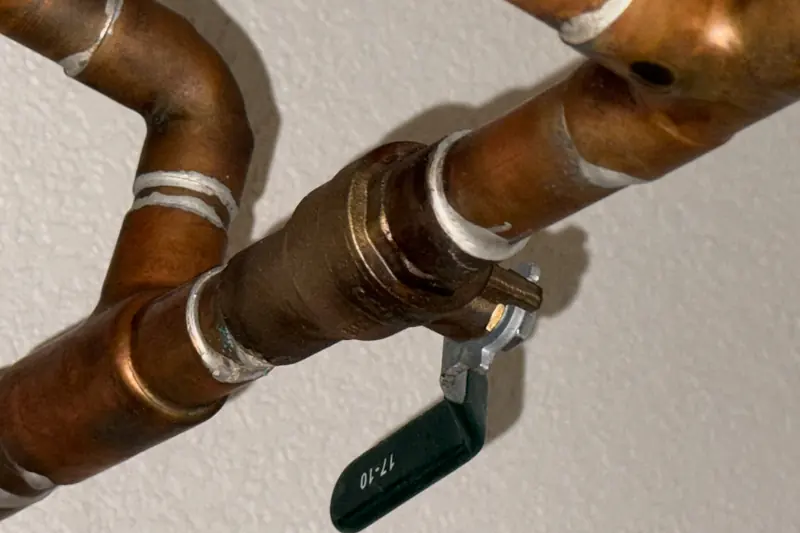
Copper is the easy one, as Figure 37.1 shows. Its color gives it away unless it has been painted, and joints are soldered rather than threaded. Solder made before 1986 may contain lead, CDC says, which is the reason the age of the house matters even with copper pipe.2
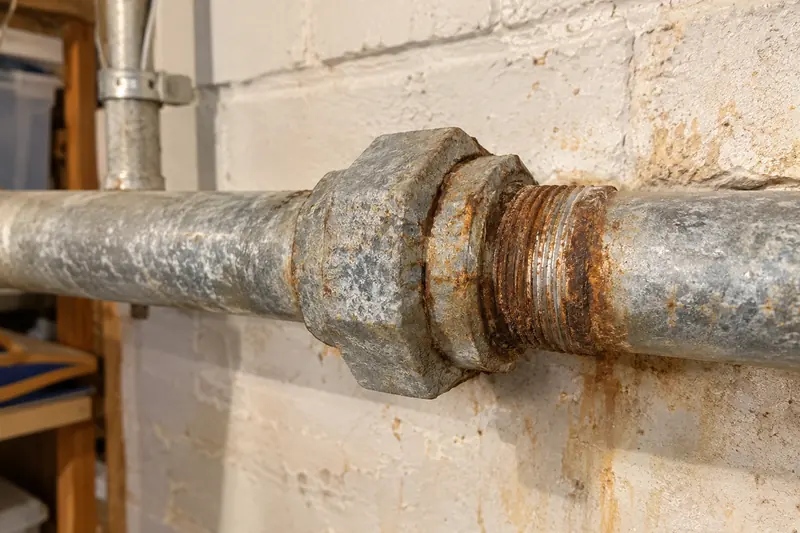
Galvanized steel is the other common old pipe. It screws together, so look for threads at the fittings, as in Figure 37.2. A magnet sticks firmly. Water can run slowly through it, and USGS says that long use of hard water in a pipe can build up scale inside it.3 EPA's advice to Chicago residents says that old, corroded galvanized iron pipe can make flushing take longer, which ties it to the lead question too.4
37.3 What should you know about polybutylene?
It is a plastic supply pipe that a Connecticut legislative working group says was used generally in homes from 1978 to 1995. The group reports that it was sold with a life span of about 30 years and that much of it has already been replaced.5 It is usually installed behind closed walls, so it is not always easy to find, and the working group found that many homeowners would not know how to identify it.5
Flexible gray plastic by itself proves nothing, because some PEX is gray too. If you see it, or if you are buying a house built in those years, ask a plumber or home inspector to look. The same group recommended that buyers and owners check how their insurance treats these pipes, which is sensible advice in any state.5
37.4 What is PEX, and why do new jobs use it?
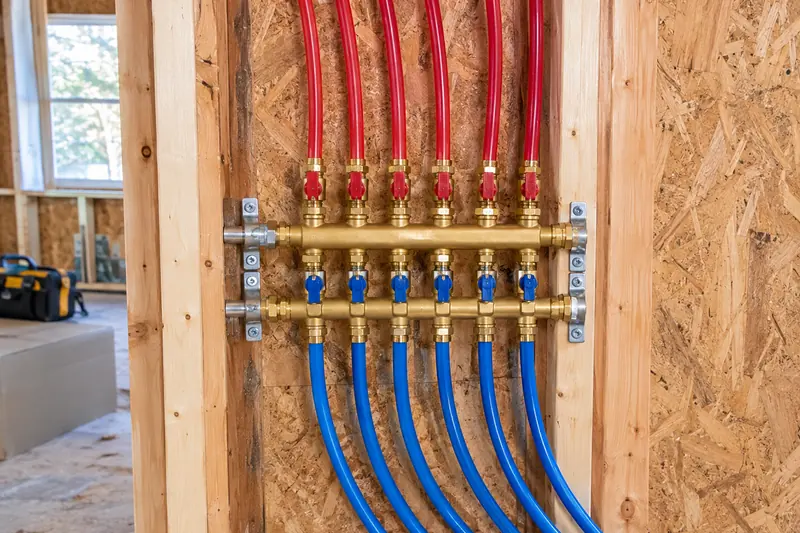
PEX is polyethylene with its molecules cross-linked, which makes it flexible and durable. HUD says it has been used in the United States since the 1980s, first for radiant heating, and that it became many builders' choice for water piping.1 It often runs from a manifold like the one in Figure 37.3, which gives individual shutoffs for each fixture and so makes work on sinks and toilets easier.1
You may see small patches of newer pipe spliced into old lines. That is common and not a sign of trouble by itself. Stock of both kinds is sold at PlumbingSupplyAndMore's copper pipe section (PlumbingSupplyAndMore has the same owners as this book) and its PEX pipe section (PlumbingSupplyAndMore has the same owners as this book). That is one place to look, and useful mostly for seeing what your plumber is talking about.
37.5 What should you expect from an old house?
Expect layers. One bathroom may have been redone in copper while the kitchen still runs on the original steel. Expect valves that have not moved in years, and test them gently before you need them, following Chapter 6. Expect fixtures with no stops at all. Expect weak flow in one place and fine flow in another, which can be a clogged aerator rather than a clogged pipe, so check Chapter 9 first and think about Chapter 7 next.
We do not give you a table of how many years each pipe lasts. The sources we read do not state them, apart from the polybutylene figure above, and a number off the internet would not tell you about your house. Condition, water and workmanship decide that.
- Start at the main shutoff and note what comes in and what goes out.
- Follow the lines you can see to the water heater and note the material there.
- Look under each sink and behind the toilet.
- Try a magnet on anything gray.
- Write down the material and where you found it.
37.6 Should you repipe?
Not because of this chapter. A pipe's age alone is not a leak. Reasons to talk to a plumber include repeated leaks, flow that has faded through a whole house, confirmed lead, or a remodel that already has the walls open, which Chapter 38 covers. Get more than one view, as Chapter 39 suggests. Pipe work often needs a permit, and that depends on your town.
Where the line falls
- Yours to do
- Identifying pipes with your eyes and a magnet; the gentle key check; noting what you find; working valves gently; asking a home inspector to look before you buy
- For a licensed pro
- Replacing or joining supply pipe where your town wants it permitted; repiping; anything involving a lead service line; opening walls to trace polybutylene
Notes
- HUD Office of Policy Development and Research, "Water Piping in the Home." huduser.gov ↩
- CDC, "Lead in Drinking Water." cdc.gov ↩
- U.S. Geological Survey, "Hardness of Water." usgs.gov ↩
- U.S. EPA Region 5, "Advice for Chicago Residents about Lead in Drinking Water." epa.gov ↩
- Connecticut General Assembly, Working Group to Evaluate the Connection Between Polybutylene Pipes and Indoor Mold, "Final Report." cga.ct.gov ↩