Chapter Thirty-One
Bangs, Hums, and Knocks
By the editors of this book. Sources checked November 2, 2026.
Water hammer is the bang you hear when a valve shuts fast and moving water suddenly has nowhere to go. Oatey, a maker of plumbing parts, calls it a hydraulic shock in the piping.1 Most house noises are harmless by comparison, and a few are worth a call. This chapter sorts them out, starting with the loudest.
31.1 What causes water hammer?
A column of water in a pipe is heavy, and it is moving. When a valve closes quickly, the water at the front stops and the water behind it does not, so a pressure wave travels back down the line. Figure 31.1 shows what happens. The pipe jumps, often against a stud, and that is the sound you hear.
The usual culprits are the fast-closing valves in washing machines and dishwashers. Those shut electrically, in an instant, and you may hear the bang partway through a cycle, with nobody near a tap. Single-handle faucets snapped shut can do it too. High house pressure makes all of this worse. Chapter 7 shows how to measure it.
Note when the bang comes and which appliance was running. That tells you nearly everything.
31.2 How does an arrestor help?
An arrestor is a small sealed chamber fitted to the supply line. It holds a cushion of air behind a piston or membrane. When the wave arrives, it compresses the cushion instead of slamming the pipe. Oatey says it should go as close as possible to the fixture making the noise.1 Many are made to screw on at a washing machine's hose connection, as in Figure 31.2, which makes this one of the easier fixes in the book.
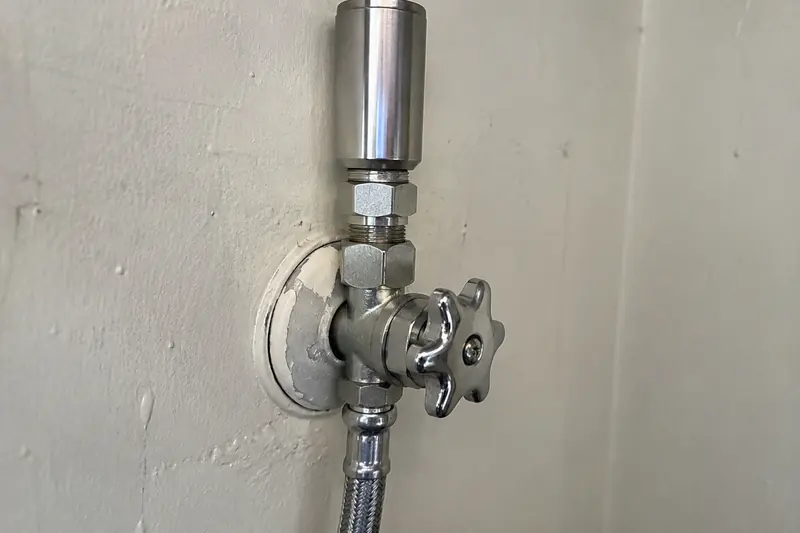
- Close the fixture stops for that appliance, as in Chapter 11, and turn off the appliance.
- Unscrew the supply hose from the valve, with a bucket and a towel ready.
- Screw the arrestor to the valve, following its instructions, and screw the hose onto the arrestor.
- Open the stops slowly and look for drips at each joint.
- Run a cycle and listen.
Older houses may have a capped length of pipe behind the wall that served as an air chamber. Those can fill with water over time and stop working, and the bang gradually returns. A plumber can advise on it. Arrestors that need soldering, or that have to go inside a wall, belong with the plumber too.
31.3 What if the bang is not hammer?
Sometimes a bang has another cause. A failed pressure regulator can bring on thumping, banging, hammering or vibrating noises in the walls, according to one California water district, along with high pressure and other symptoms.2 That district says a healthy house should see 30 to 80 psi.2 A gauge on a hose faucet answers the question in five minutes. That district treats the regulator as the customer's, on the customer's side of the meter.2 Local utilities differ, so ask yours. Replacing one is a plumber's job.
Pipes that are not fastened can rattle at the slightest disturbance. If you can reach the stretch that knocks, in a basement or crawl space, a pipe strap or a bit of padding at the point where it touches wood can quiet it. Use a strap of the right size. Do not squeeze or kink the pipe, and be careful where you drive a screw.
31.4 What do the other noises mean?
Most of the rest come from heat or a slow leak of water, and most are worth listening for rather than worrying about. Rheem, a maker of water heaters, gives a useful sorting for the sounds of a heater.3
| Sound | Likely cause | What to do |
|---|---|---|
| Single bang when a valve closes | Water hammer | Fit an arrestor or check pressure |
| Tick or click as hot water runs | Pipe expansion, or heat traps at the heater | Usually nothing |
| Hum from an electric heater | Elements working | Usually nothing |
| Popping or rumbling from the tank | Sediment on the bottom | See Chapter 25: electric with the breaker off, gas by the manual or a plumber |
| Hiss or sizzle at the heater | Water reaching hot parts; a leak | Call a plumber |
| Hiss from the toilet | A fill valve that does not fully close | Check the toilet |
| Water sound with every tap closed | A leak | Run the meter test |
A few of those deserve a sentence more. Popping or rumbling is the classic sign of sediment, and Rheem says it comes from water heating beneath the deposits.3 Flushing is covered, with its cautions, in Chapter 25. The sizzle is more serious, because Rheem's list of causes includes water dripping onto a hot burner on gas models and a leaking element gasket on electric ones.3 Neither is a homeowner repair. Treat it as a call, and do not open any panels to look.
Ticking in walls is usually pipes growing as they warm. Hot water pipes grow when hot water runs, and they catch against whatever holds them. It is annoying and rarely harmful. A hiss from a toilet goes to Chapter 13. For a sound of running water when nothing is on, go to Chapter 28 and read the meter.
31.5 Which noises need a call today?
Most noises can wait, but some cannot. A relief valve hissing or running is covered in Chapter 24, and if it pours very hot water, that chapter gives you the steps. Hissing near a gas pipe or a gas heater, or any smell of gas, means you leave the building first without using switches or a phone inside, and call 911 and the gas utility from outside and well away. If a carbon monoxide alarm sounds, leave first and call 911 from outside. No noise is worth staying to investigate in those cases.
For everything else, keep your notes: what you heard, when, and what was running. Those notes turn a vague complaint into a short visit.
Where the line falls
- Yours to do
- Tracing a bang to an appliance; a screw-on arrestor at a washer or similar connection; testing pressure with a gauge; a strap or padding on a pipe you can reach; recording sounds
- For a licensed pro
- Arrestors that must be soldered or set in a wall; a new pressure regulator; hissing or sizzling at the heater; anything that sounds like moving water behind a wall