Chapter Thirty
Frozen Pipes
By the editors of this book. Sources checked November 2, 2026.
Frozen pipes are pipes where water has turned to ice, blocking the flow and building pressure that can split the pipe. The usual first sign is a faucet that gives a trickle or nothing on a very cold morning. A crack often shows itself only when the ice melts, so know where the main shutoff is before you start to thaw anything. That is the most useful thing we can tell you.
30.1 Where do pipes freeze?
Pipes in attics, crawl spaces and outside walls are the vulnerable ones, says the Kentucky Division of Water, especially where cracks or gaps let cold outside air flow across them.1 A cabinet on an outside wall, a pipe over a garage and a hose faucet line through a cold sill are all typical.
When water freezes, it expands. If it does so in a closed pipe, it can burst the pipe, and serious damage follows.1 Chapter 29 covers that morning. The rest of this chapter is about avoiding it.
30.2 How do you keep pipes from freezing?
Most of the work happens in the fall.
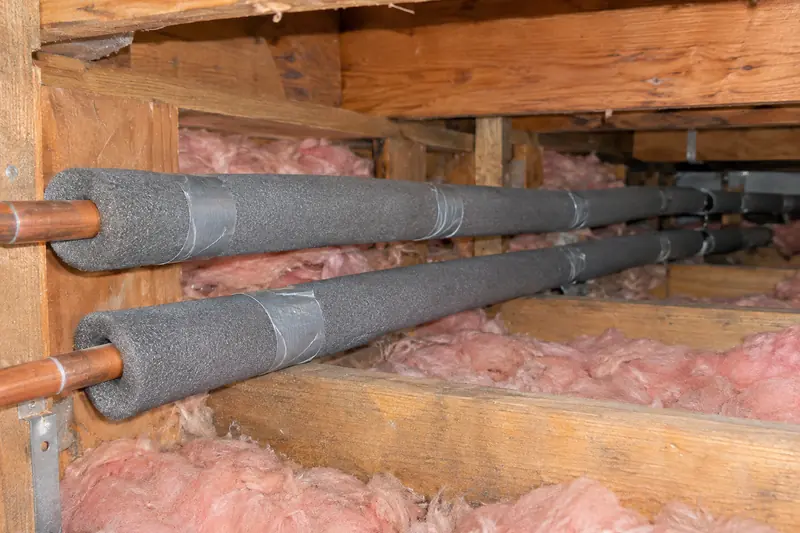
Insulate first. Wrap hot and cold pipes in the vulnerable spots,1 as in Figure 30.1. Close the gaps that let cold air reach them. Seal around where pipes and outside faucets pass through the wall.1 2 University of Illinois Extension also mentions heat tape, UL approved.2 Follow the instructions on the package closely, since it is an electrical product.
In a hard cold snap, a few simple moves help:
- Let a trickle run from a cold faucet, the one farthest from the water meter or one that has frozen before. Moving water is harder to freeze, and the open tap helps relieve pressure if ice does form.1
- Open kitchen and bathroom cabinet doors so warm air reaches the pipes behind them.1 2 Move any cleaners out of reach of children while the doors stand open.
- Leave the heat on overnight, even if you normally turn it down.
30.3 What if you go away in winter?
Illinois Extension says to leave the heat on and set no lower than 55 degrees, and to have someone check the house daily to be sure the heat is still on.2 That check matters because a failed furnace in an empty house can otherwise go unnoticed for days.
For a longer absence, Illinois Extension and Kentucky both mention draining the water system entirely.1 2 That is more involved than it sounds. Illinois notes that indoor sprinkler systems are an exception, and the water heater needs handling as well, since an electric element must not have power in an empty tank and a gas heater has its own requirements. If you want a house drained for the season, have a plumber do it the first time and show you how.
30.4 How do you thaw a frozen pipe safely?
You thaw it slowly, with gentle heat. Never use a flame. Before you start, make sure you know where the main shutoff is and that nobody is standing where a split pipe could soak them. If you can see a crack or the pipe is already leaking, stop and close the main first.
- Open the faucet the pipe serves, fully. Open both handles if it has two.1
- Remove any insulation on the frozen stretch.1
- Wrap the pipe with towels soaked in hot water, starting where it is most exposed to the cold, and replace them as they cool.1 Mind your hands.
- If there is no standing water anywhere near you or the pipe, you may use a handheld hair dryer or an electric heating pad instead.1
- Keep going until full water pressure is back.1 Then check along the pipe for drips.
- If you cannot find or reach the frozen spot, or the pipe does not respond, call a licensed plumber.1
With a hair dryer, keep it moving, keep the cord away from the wet, and do not use it if there is any water on the floor. A heating pad gets the same rule. If water appears where it should not, close the main and go to Chapter 29.
30.5 Why is a flame never acceptable?
A blowtorch can make the water in a frozen pipe boil and cause the pipe to explode, according to Kentucky.1 That is not the only danger. No blowtorch, kerosene or propane heater, charcoal stove or other open flame belongs near a frozen pipe. All of them are a fire risk in a house, and they bring a severe risk of carbon monoxide.1 Illinois Extension says the same in fewer words: never try to thaw a pipe with an open flame or torch.2
The torch is a trap because it often seems to work. Solder softens, nearby framing dries and catches, and insulation in a wall smolders where you cannot see it. Buying a plumber's call-out is far cheaper. If you smell gas, leave the building first, touching no switches and using no phone inside; call 911 and the gas utility from outside and well away, and stay out until they clear it. If a carbon monoxide alarm sounds, leave first and call 911 from outside.
30.6 What should you do after a freeze?
Ask why that pipe froze and fix the cause. A run that froze once will likely do it again in similar weather, and Kentucky suggests insulating exterior walls and sealing around doors, windows, house faucets and outlets if the cold is getting in.1 A plumber can reroute or protect a stretch that cannot be helped with foam alone. Note the date and the outdoor temperature too. That tells you the next time to set the taps trickling.
Also look at the heater. If a hot water pipe froze, the tank is still full, but it may have no flow for a while. Keep an eye on the relief valve described in Chapter 24, and if anything about it changes, call a plumber.
Where the line falls
- Yours to do
- Insulating exposed pipe; sealing drafts; trickling a cold tap; opening cabinet doors; keeping the heat at 55 degrees or above when away; thawing a reachable pipe with hot towels, a hair dryer or a heating pad
- For a licensed pro
- Thawing a pipe you cannot find or reach; repairing a split; rerouting a run that keeps freezing; draining a house for the season; exterior wall insulation work
Notes
- Kentucky Division of Water, "Prevent Pipes From Freezing" (June 2024). eec.ky.gov ↩
- University of Illinois Extension, "Cold Weather, Frozen Pipes? Extension Gives You All You Need to Know." extension.illinois.edu ↩