Chapter Twenty-Six
No Hot Water
By the editors of this book. Sources checked November 2, 2026.
No hot water usually means the heater has lost its power or its flame, and the first thing to settle is whether yours runs on electricity or gas. The two paths share almost nothing after that. An electric heater allows you one safe check at the breaker panel. A gas heater allows you to read its label and make a call. Read the section for your fuel and skip the other.
26.1 Is your heater electric or gas?
Look at the label on the tank, which names the fuel. Chapter 22 also gives the quick signs: a heavy electrical cable and no vent means electric, while a vent pipe rising from the top and a small pipe running to a control near the bottom means gas.
If you smell gas, leave the building first, touching no switches and using no phone inside; call 911 and the gas utility from outside and well away, and stay out until they clear it. If there is water on the floor near the heater, outlets, a panel or other appliances, do not walk through it. Chapter 29 tells you what to do instead.
26.2 What should you check on an electric heater?
Check the breaker, and go no further than that. Figure 26.1 shows a typical panel. You are looking for the switch marked for the water heater.
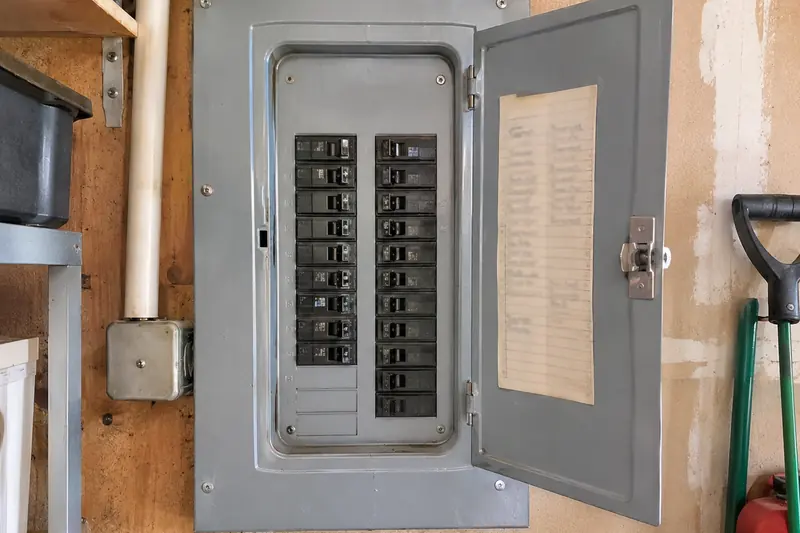
- Think back first. If anyone has drained or flushed the tank, confirm that it is completely full before the breaker goes on. A hot tap should run steadily with no air.
- Stand on a dry floor and open the panel door. If the floor or panel is wet, stop. Go outside and call the electric utility or the fire department from there.
- Find the water heater breaker and see whether it has tripped.
- If it has tripped, push it firmly to off, then back to on, one time only.
- Wait. A. O. Smith's electric manual says a tank may take two hours to heat up.5
- If the breaker trips again, or the water is still cold after a good wait, leave the breaker off and call a plumber or electrician.
Stop there. A breaker that trips twice is reporting a fault, and it should not be argued with. Many electric heaters also have a high-limit reset behind an access panel. That reset trips for a reason, and the parts behind the panel are live unless the breaker is off. Replacing or repairing elements and thermostats is electrical work, so leave it to an electrician or a plumber who does this work. Adjusting the dial is a different matter, covered in Chapter 23. Your part is to tell them what the breaker did.
26.3 What should you do on a gas heater?
Any gas smell changes everything. Leave the building right away. Do not touch a light switch, do not use a phone inside, and do nothing that could make a spark. Call 911 and the gas utility from outside and well away from the smell. Stay out until the utility or the fire department tells you it is safe.2 Do not try to find the source first.
If there is no smell, the usual story is that the pilot has gone out or the burner is not coming on. Read the printed label on the heater. It is written by the maker for that model. If the label leaves you unsure, or you would simply rather not, call the gas utility or a plumber. This book does not walk through lighting a pilot, and it gives no steps at the gas control or the burner.
A pilot that keeps going out, or a burner that will not stay on, is something for a professional to look at. So are the signs in Chapter 22: soot, melted plastic washers, a flue that has come loose.3 Some gas heaters also need house electricity for a fan or control, and your manual will say so. Ask your gas utility about outages when you call.
26.4 Why is there some hot water, just not enough?
A heater that is working poorly usually gives you some warm water. That points in a different direction than a dead one. A. O. Smith's manual lists the common causes,1 and the table below sorts them.
| What you notice | What it may mean | What to do |
|---|---|---|
| One shower is lukewarm, other taps are hot | A worn mixing valve at that shower | Look at the valve, not the tank |
| Runs out sooner than it used to | Sediment on the bottom of the tank | See Chapter 25: electric with the breaker off, gas by the manual or a plumber |
| Runs out with the family all home | Tank too small for the demand | Stagger use, or talk to a plumber |
| Started soon after a new install | Reversed connections or a damaged dip tube | Call the installer |
| Heater seems to run all the time | A hot water leak somewhere | Look for the leak |
Flushing is in Chapter 25, and the search for a leak is in Chapter 28. If the water is too hot rather than too cool, do not wait. See Chapter 23 and measure it, and if a thermometer reads well over the setting, call a plumber.
26.5 What if the water is coming from the tank?
A tank that has rusted through cannot be repaired. Work in this order. If water is near the heater, outlets or a panel, do not walk through it; go outside and call the electric utility or the fire department from there. On an electric heater, switch the breaker off first, and only from a dry spot. Then close the water heater valve if you can reach it from dry footing, or the main shutoff as described in Chapter 29. On a gas heater, do nothing at the control and ask the plumber. Put towels down if the floor is safe to walk on, and photograph what you see.
26.6 When is it time for a new heater?
The Department of Energy's 2022 guide says most storage heaters last 10 to 15 years,4 so a failing heater near that age is a reason to ask about replacing it before putting money into repairs. Replacing a water heater is licensed work in this book, on either fuel. Permits for the job vary by town. Chapter 27 covers what to consider before you choose, and Chapter 39 covers how to hire well. A cold-water morning is a poor time to decide in a hurry, so a little thought ahead of the failure is worth having.
Where the line falls
- Yours to do
- One breaker reset from a dry floor on an electric heater; reading the printed label on a gas heater; telling lukewarm from no hot water; gathering the model number and age for the call
- For a licensed pro
- Elements, thermostats and resets; anything at a gas control, burner or pilot beyond the printed label; a heater leak; choosing and installing a replacement
Notes
- A. O. Smith, "Installation Instructions and Use & Care Guide, Residential Gas Water Heater." assets.hotwater.com ↩
- Washington Utilities and Transportation Commission, "Pipeline Emergencies." utc.wa.gov ↩
- Pacific Northwest National Laboratory, Building America Solution Center, "Look for Signs of a Gas Water Heater Backdrafting." basc.pnnl.gov ↩
- U.S. Department of Energy, "Energy Saver Guide" (2022). energy.gov ↩
- A. O. Smith, "Residential Electronic Thermostat Electric Water Heater: Installation Instructions and Use & Care Guide." assets.aosmith.com ↩