Chapter Twenty-Seven
Tankless, Heat Pump, or Tank
By the editors of this book. Sources checked November 2, 2026.
Tankless vs tank water heater is mostly a question of how your household uses hot water: a tankless unit heats it only as it flows, while a tank keeps a supply ready. A third choice, the heat pump model, keeps the tank and changes how the heat is made. None is right for every house. All three are installed by licensed people, so the job of this chapter is to make you a better customer.
Most numbers here come from the Department of Energy's Energy Saver guide, dated 2022. Check for newer figures before you buy.
27.1 What is the actual difference?
A conventional storage heater, described in Chapter 22, remains the most popular kind. It burns natural gas, propane or fuel oil, or uses electricity,1 and it keeps its water hot all day.
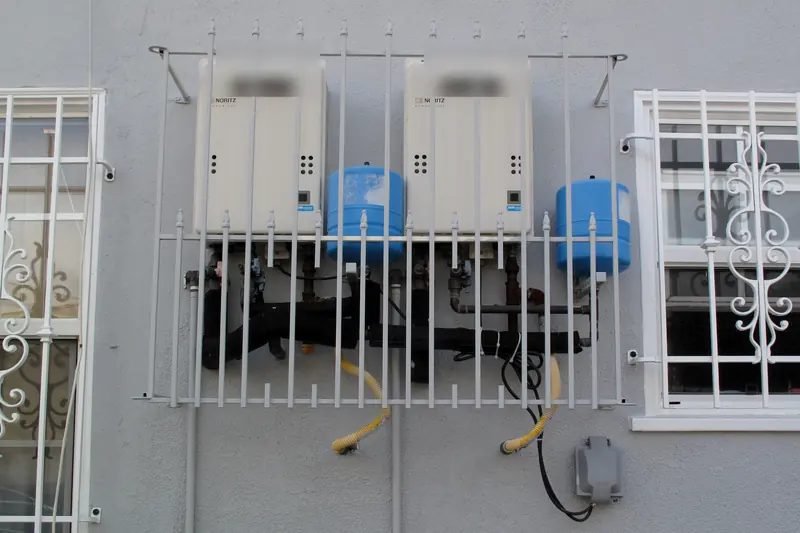
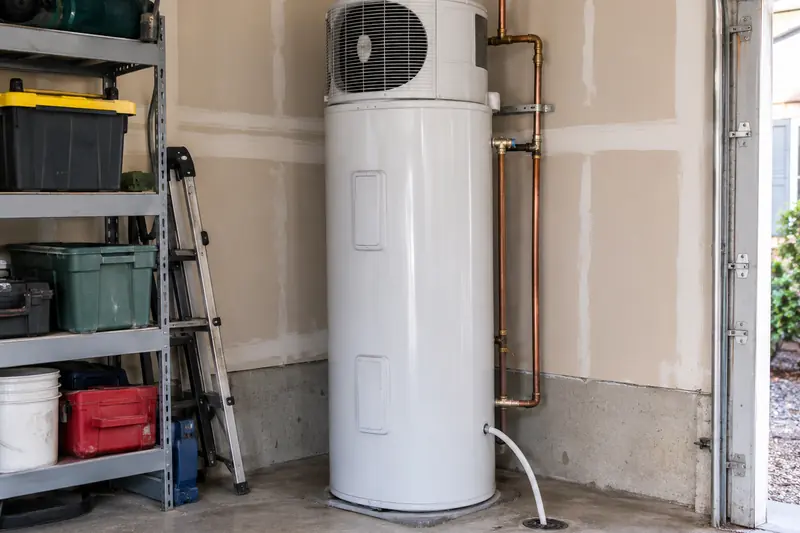
A tankless heater, shown in Figure 27.1, has no stored supply. Water passes through it and is heated on the way. It does not run out in the same way a tank does, but it can only heat so much water at once. A heat pump water heater, shown in Figure 27.2, has a tank but moves heat from the air around it into the water, which takes far less electricity than making the heat directly.
27.2 Does a tankless heater really save money?
It saves energy, and how much depends on your use. For gas units, the guide says homes using 41 gallons or less of hot water a day can see them run 24 to 34 percent more efficiently than a conventional tank. For homes using a lot, around 86 gallons a day, the figure falls to 8 to 14 percent.1 So the savings shrink as use grows.
The limit is demand at one moment. The guide says that if you tend to run hot water in several places at the same time, you may need two or more tankless units to keep up.1 It also says these systems have unusual installation requirements and that you should consult a certified technician before buying.1
The guide also gives an edge on life: tankless heaters can last more than 20 years, against 10 to 15 for most storage heaters.1 That matters when you weigh a higher purchase. Ask your installer for a written price on both, as Chapter 39 suggests, since installation costs vary with the house and we give no figures for them here.
27.3 What does a heat pump water heater ask of a house?
The guide says an ENERGY STAR certified heat pump water heater uses 70 percent less electricity than a standard electric model to make the same hot water.1 It is two to three times as efficient as a conventional electric heater.1 That is a large number, and it comes with conditions.
It suggests considering one if you live in a climate where temperatures stay between 40°F and 90°F all year.1 Few places hold that range all year, so ask the installer what your climate and your particular space mean for the model. Because it takes heat from the air around it, the room gets cooler and drier while it runs. In a basement, the guide says, it can provide dehumidification in summer.1 It also warns that the technology can pose installation challenges, and it tells you to consult an installer before buying.1
Space around the unit, a way to get rid of condensate, and a suitable circuit are all things the installer should settle at your house before you commit. If you would like to see what the category looks like, PlumbingSupplyAndMore's hybrid heat pump section (PlumbingSupplyAndMore has the same owners as this book) is one place to look, and not necessarily the best one. Bring what you learn back to your installer.
27.4 Which one suits which house?
Here is the comparison in one place.
| Tank | Gas tankless | Heat pump | |
|---|---|---|---|
| Stores hot water | Yes | No | Yes |
| Stated life | 10-15 years | More than 20 years | Not given separately |
| Energy figure | The baseline | 24-34 percent better at 41 gal/day or less; 8-14 percent at about 86 gal/day | 70 percent less electricity than standard electric |
| Watch for | The tank can run out | Several taps at once; special installation | Climate and space; installation challenges |
A few plain questions will narrow it down. Do several people shower back to back, or at the same time? A tank or more than one tankless unit answers that. Is your use small and steady, say a couple in a small house? That is where tankless savings are strongest. Is your present heater electric, with space around it and a mild climate? That is the case for a heat pump.
Consider your present dishwasher too. As we saw in Chapter 23, the guide says a dishwasher with its own heating element lets you set water at 120°F. That setting stays the same whichever heater you pick.
27.5 Who installs it, and what do you ask?
Licensed people do, on any fuel. In this book, that is not a close call. A new heater can mean new gas piping, new venting, a new circuit, or all three. It also needs a relief valve and discharge pipe as described in Chapter 24. Gas piping and venting are the licensed trades' work, and larger electrical loads belong to an electrician. Whether a permit is needed depends on your town, so ask your town and your installer. Do not assume.
Good questions to put to an installer are short. What will it cost in full, including any gas, venting or electrical changes? What maintenance does this model want, and who will do it? Where will the water go if it leaks? Who handles the permit if one is needed? What happens if it fails in the first year? Get the answers in writing.
Whatever you install, the safety habits carry over. Set it at 120°F, keep the discharge pipe open, and keep a carbon monoxide alarm working if there is a flame in the house. However new the heater is, the rule does not change. If you smell gas, leave the building first, touching no switches and using no phone inside; call 911 and the gas utility from outside and well away, and stay out until they clear it.
Where the line falls
- Yours to do
- Working out your daily and peak hot water use; reading labels and energy guides; collecting written bids; asking about permits; keeping the area around the new heater clear
- For a licensed pro
- Choosing the final size with an installer; removing the old heater; gas lines, venting and new circuits; the relief valve, discharge pipe and any permit work
Notes
- U.S. Department of Energy, "Energy Saver Guide" (2022). energy.gov ↩